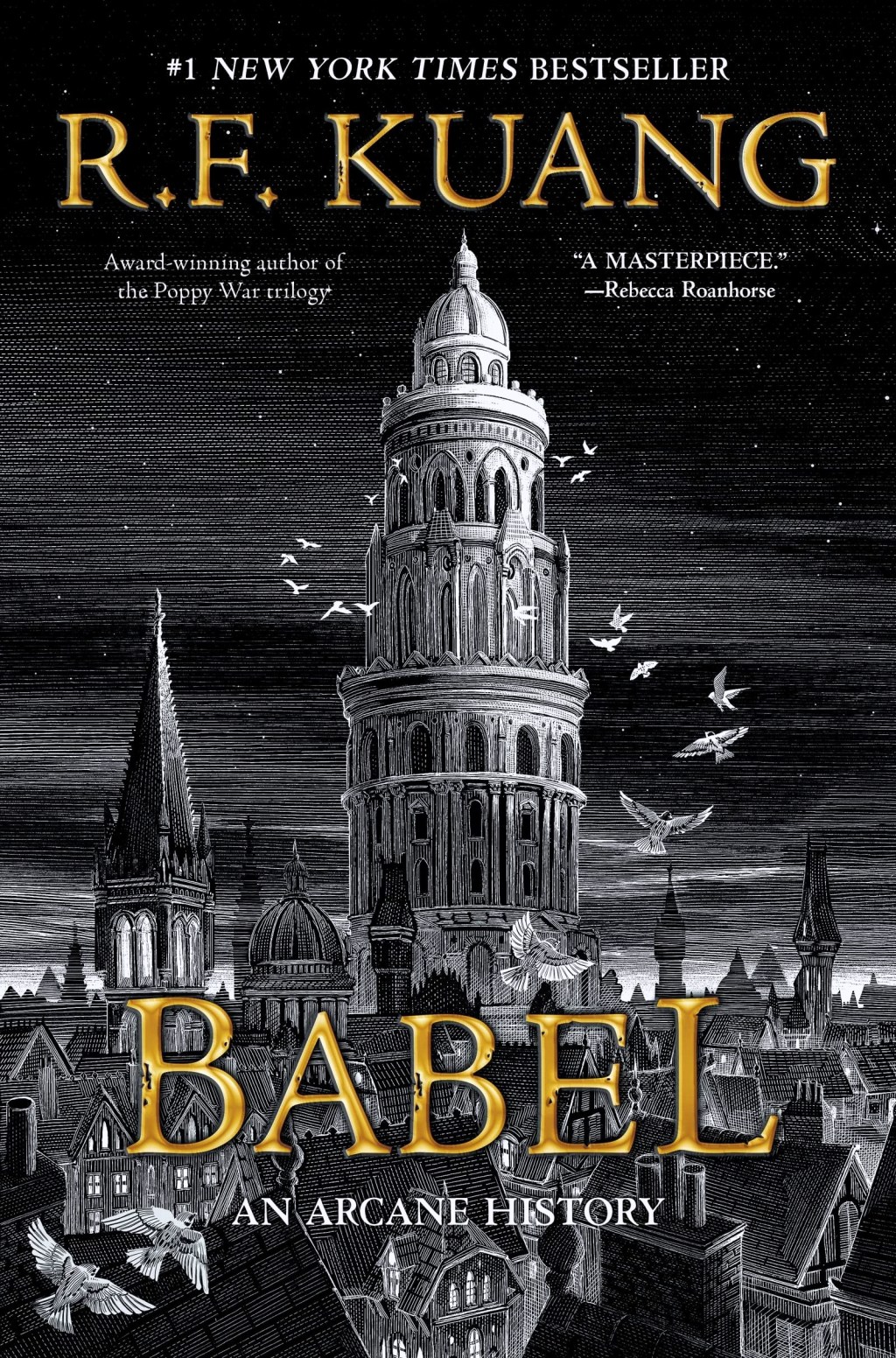
Babel is an inventive and provocative piece of fiction. I really admire Rebecca Kuang for her clear passion for her Chinese cultural roots and the extent to which she has clearly thought deeply about the role academia plays in socio-politics. Babel is truly a wonderful fictionalized distillation of ideas about these themes, presented in a wonderful blend of historical fiction and fantasy.
Kuang’s portrayal of an alternate universe British Empire powered by silver enchanted through language is so creative and I really enjoyed her characters, whose friendships, fears, challenges, and yearning for belonging and truth reminded me of the highest highs of the Harry Potter series. For a book that is, at its core, about language and imperialism, Babel is a brisk and well-paced read with more than enough intrigue and action to keep readers turning pages between lectures and philosophical debates.
Unfortunately, there were a few things that keep Babel from being truly great. First, I was not entirely satisfied with some characters’ arcs. This is particularly true of Professor Lovell, Griffin, and Ramy. I could not help feeling there was always something left unsaid between them and the main protagonist, Robin, and that their motivations and personalities could have been given just a little more depth. Second, I was disappointed that Kuang did not take the opportunity to make the narrative and social commentary a bit more nuanced and sophisticated. Once it became clear that the narrative was devolving into a clear “white people = bad, non-white people = good” dichotomy, I found the plot more predictable and myself a little less invested in what Kuang was trying to say. I would also note that the ultimate choice Robin makes in the final 100-or-so pages did not sit well with me, and I would have preferred having a protagonist who forged a new path rather than eventually falling into a particular path out of desperation and anger. Finally, I think Kuang’s tendency to over-explain with repetitive descriptions, footnotes, and a frustrating tendency to undercut critical action scenes with jarring tonal shifts really did Babel a disservice and there were several moments where Kuang spoiled her own story. .
Overall, I enjoyed Babel and I look forward to Kuang having a long career. What she has already achieved as a young novelist while also racking up multiple advanced degrees from some of the best universities in the world is so impressive and I am rooting for her success.
 The Once and Future Lit