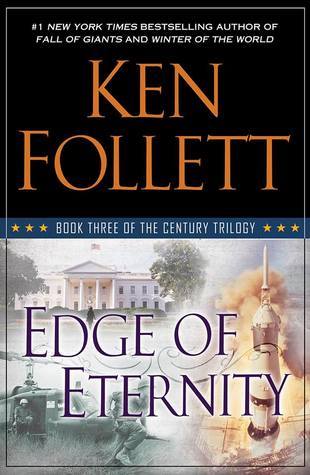
Well, Edge of Eternity did something the first two books did not: it bored me.
I think writing it bored Follett too. About halfway through the book, he seems to just give up on any semblance of a plot and condenses a period as long as the first two books combined into about 400 pages.
I’m not sure if I was bored because this book was more boring than the others, or if it was just that after reading the others, this one had nothing new to offer. Even the most contrived plot devices, gross sex descriptions, idiotic character choices, and cliches couldn’t surprise me anymore.
In Fall of Giants, I found most of the characters interesting. In Winter of the World, they were ridiculous to the point of being entertaining. But in Edge of Eternity, I found myself sometimes forgetting who was who. And I think I figured out why: 1) Follett’s characters are just recycled archetypes from his previous books, and 2) Follett does not treat his characters in a way that makes me think I should care about them as a reader. I mentioned this in my discussion of Walter’s character treatment in Winter of the World, but it is even worse here in the way Follett unceremoniously dumps two of the best and most important characters across all three books into the garbage heap. Both Ethel and Maud’s deaths are unceremonious write-offs that elicit almost zero emotional reaction from their loved ones or the author himself. After spending over 2500 pages with these characters only to see their arcs ultimately fizzle out and wither into nothingness, why on earth should I care at all about any of the remaining characters, new or old?
The plot contrivances and characters’ run-ins with history are so out of control at this point that I knew there was no going back after one of Follett’s fictional characters aborted her would-be love child with President Kennedy. At that point (fairly early on in the book) I realized Follett had once again given into the terrible instincts that sunk Winter of the World, so I decided the most fun I could try to have with this book was to see how many points I would get on the Ken Follett Bingo Card: accidental pregnancy announced within 5 pages of Follett describing a young couple having unprotected sex; some form of rape or sexual violence; descriptions of “pointy nipples” and “curly pubic hair;” main characters from different countries just happening to run into each other; a character becomes a member of parliament; there’s an unambiguously evil character worthy of being on the Disney villain roster. I’m sure there are more I’m not thinking of at the moment.
Far less fun was being astounded by the extent to which Follett reduced his characters to the most cliche, unsophisticated, and at-times offensive stereotypes or archetypes imaginable. Readers can look forward to reading about black characters heartily tucking into fried chicken, collard greens, and corn bread. If a characters is a young woman she is either so horny that she has to “clamp her teeth” to prevent herself from moaning at the mere thought of sex, or she is a #girlboss who “don’t need no man.” The young men are either boring copies of Follett’s previous characters who work in politics and serve as a justification for long historical exposition dumps, or they are evil white men who are some combination of fat, ugly, racist, and socially awkward. Multiple times, Follett uses “it’s 1968, the age of free love,” to push an infidelity plot device along, I counted three accidental pregnancies in fewer than 100 pages, and twice he describes sex using such eloquent prose as, “They did not. Then they did.”
This is not a major plot point and I alluded to it before, but I just wanted to offer my deepest sympathies to the character of Rebecca. I can’t recall reading another novel where an author treated one of his own creations so badly that he completely turned her entire character arc upside down just to turn her into a sex object for one chapter before reverting her to her previous state of being.
Edge of Eternity is just a hair better than its predecessor, mostly because it spends so much time being boring that it never finds an opportunity to be quite as offensive to the history it aims to cover or to the reader’s intelligence. As with Winter of the World, anyone who has read a single book about the Civil Rights Movement, the Cold War, or any other historical touchstone covered in this book can expect to learn nothing new. If you’ve been around since Fall of Giants, you can look forward to Follett giving you the middle finger as the characters you’ve invested thousands of pages in disintegrate into dust, while their shallow grandchildren make their stuffy Victorian predecessors look like the most interesting people ever to walk the earth. Good riddance to this trilogy. I would not recommend Edge of Eternity to anyone (even someone who liked Fall of Giants or Winter of the World). Better to imagine how the story ends than to watch foul-smelling paint dry for 1100 pages.
 The Once and Future Lit