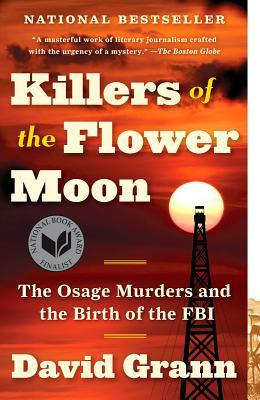
I had incredibly high expectations of Killers of the Flower Moon given its many accolades and the hype surrounding the upcoming film adaptation. Specifically, I expected this book to be much more of a true crime thriller than it turned out to be. The set-up was certainly there with Grann’s description of Anna Brown’s brutal murder. However, the perpetrators and their motives are not hard to spot pretty quickly.
Instead, where Killers of the Flower Moon shines is in its success as a work of journalism that brings to life a fascinating historical setting and period that has largely been forgotten in mainstream public consciousness. David Grann’s research into the Osage tribe, the “Reign of Terror” of the 1920s, and the individual members of the community (past and present) is truly exceptional, and there is so much to learn from reading his work. I for one had never heard of the Osage, and I certainly had no idea that they (or any indigenous tribe) in the early twentieth century could claim to be the wealthiest people per capita in the world. I certainly had not heard of the complex legal framework of headrights and guardianships. And I would never have linked the rise of J. Edgar Hoover and the FBI to a series of murders on tribal land in Oklahoma.
This may not be the most suspenseful serial killer story out there, but it is frightening in the way it serves as a reminder of the worst of human nature. There may not be a boogeyman lurking in the shadows, but the truth may be far worse: the existence of people so greedy that they will slaughter their neighbors, destroy a community, deceive the people they are meant to love, and weaponize the institutions designed to protect the innocent and the vulnerable.
 The Once and Future Lit