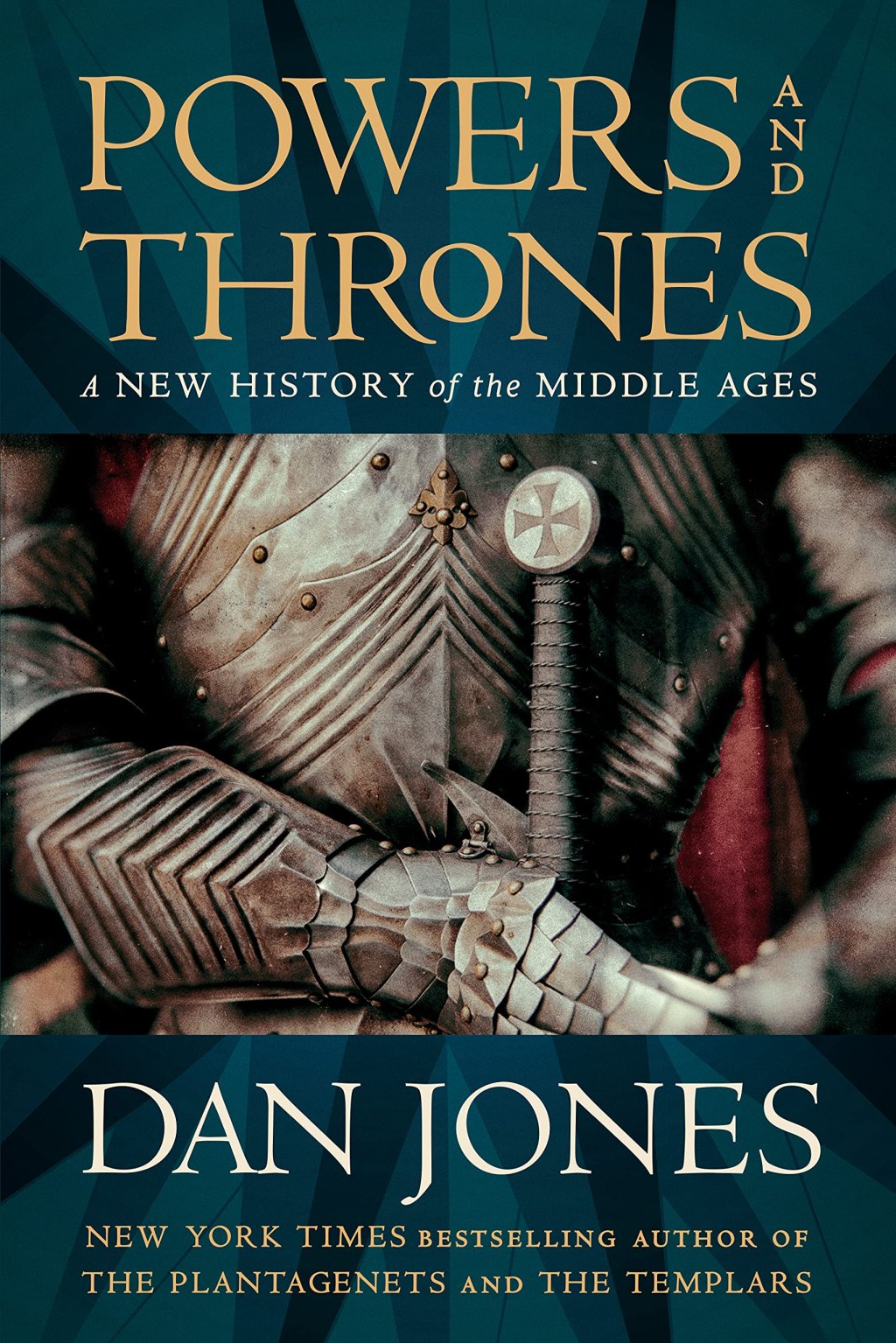
I loved this book. It is rare to find a history book that can successfully juggle the tasks of being accessible, educational, entertaining, and thought-provoking. In Power and Thrones, Dan Jones absolutely succeeds at striking and maintaining that delicate balance. In the introduction, Jones promised, “The book you are about to read tells the story of the Middle Ages. It is a big book, because that is a big task… There will be times when that may feel a little bit overwhelming. But I promise you, it is going to be fun.” Each promise made was kept.
Power and Thrones truly reads like a story (or a series of tales). Jones does a great job bringing the characters of the Medieval world to life and showing that the heroes, villains, and oddballs of the Middle Ages are as fascinating as the creations of fiction, and as relatable as the people we meet and know in our own lives.
Jones also managed to exceed my expectations for the full scope of what would be covered in this volume. Jones makes it clear in the introduction that this book, by design, is Euro-centric and is not intended to cover a full millennium of world history. This made sense given that the entire Medieval framework is Western European by definition and any notion of the Dark Ages is nonsensical in the context of thriving Arab and Chinese Empires, or amongst the peoples of the Americas, Sub-Saharan Africa, and elsewhere who were entirely outside the fallout of the collapse of the Classical world and the Western Roman Empire. That said, readers of Power and Thrones can look forward to excellent chapters on the histories of the Middle East during the rise of the Islamic Caliphates, the Eastern Roman Empire and the Eastern Mediterranean, and the Mongol Empire in Asia.
Jones also exceeded my expectations in how successfully he made me pause and think deeply about how life in the Middle Ages relates to life today. Some historians go too far in trying to force parallels and connections, but Dan Jones did a great job painting a picture in a way that was not heavy handed, forced, or explicitly ideological. One of the things I love most about studying history is the sense of grounding and purpose that comes with feeling connected to our collective story, understanding the recurring threats and challenges we face, and finding wisdom and hope in the creativity, ingenuity, and resilience with which our ancestors overcame their great trials. Power and Thrones is the perfect book for any reader looking to make deeper sense of how much a world riddled with pandemics, wars, ideological crusaders, technological upheavals, and socio-political tribalism can be torn asunder and made anew.
My only criticism of this book lies in the editing. I noticed a few minor typos (mostly missing words) at several points throughout the book. I hope this will not be an issue in later printings. I also personally would have preferred incorporating more of the substantive footnotes into the body of the main text, but that really is not something I can knock the book for.
Overall, I highly recommend this book if you want to: learn a lot about the Middle Ages; gain a deeper understanding of the evolution of religious thought, art, philosophy, warfare, and economics during the transition from the ancient to the modern world; be entertained by stories of many of history’s greatest monks, knights, emperors, merchants, explorers, visionaries, and revolutionaries; and gain a new lens through which to process contemporary life and the enduring legacy of the Medieval world.
 The Once and Future Lit