
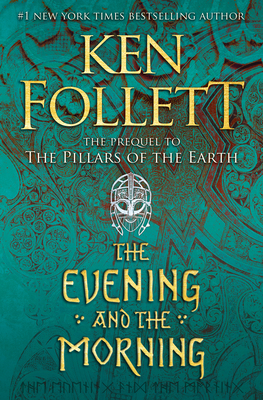
Ken Follett’s first two Kingsbridge novels, The Pillars of the Earth and World Without End are among my favorite works of historical fiction. The third entry, A Column of Fire, was not as strong, and I deeply disliked most of Follett’s Century Trilogy. So it is a huge relief that I enjoyed The Evening and the Morning, Follett’s prequel to The Pillars of the Earth. The book is not quite as impressive as Pillars of the Earth or World Without End, but is worthy of sitting comfortably alongside those works.
The more I read Follett’s sweeping historical fiction tomes, the more I realize that at their core, they largely all share the same skeletal structure of Pillars of the Earth and many of the character archetypes are re-skinned each time. In The Evening and the Morning, Edgar is a good-natured and talented young builder, much like Jack in The Pillars of the Earth. Ragna is a competent entrepreneur like Aliena, Alred is pious clergyman like Phillip, and Wynstan is the wicked bishop in the mould of Waleran. I suppose I could ding Follett for this, but I actually think these archetypes work very well in the time periods in which these earlier Kingsbridge novels are set, and why they seem to come apart at the seems a bit in A Column of Fire and certainly in the Century Trilogy. In 10th and 11th century Anglo Saxon England and through the Middle Ages, it makes sense that ambitious and corrupt people would be in the church and in the nobility, that a compelling female protagonist would not merely accept a subservient position, and that learning a trade such as building is the route for a young protagonist to dig his way out of poverty and obscurity.
The relatively confined geography of The Evening and the Morning also lends itself much better to Follett’s storytelling style than when he writes about more modern periods. There is way more focus, fewer plot contrivances, and less jumping around. For a novel about human beings striving for timeless desires such as love, sex, money, power, safety, and justice, the more confined space allows for a more intimate and believable tale.
I also really want to commend Follett for the work he did here to reconstruct Anglo Saxon England out of the relatively few historical scraps we have today. Anglo Saxon marriage, slavery, justice, statecraft, theology, education, and economics are well-developed and vividly depicted, particularly in the first half of the novel. The subplots about Blod’s enslavement, the forgery of coins, Edgar’s family and their farm, and Ironface the outlaw were particularly interesting.
One of the most compelling and fun parts of reading a Ken Follett novel is when the wicked characters act so despicably that you, the reader, have as strong a negative emotional reaction to them as the protagonists do, and you feel as strong a sense of justice when they ultimately get their just desserts. The Evening and the Morning has some really great moments on this front, particularly with setting up how vile the villains are. Dreng in particular is nasty piece of work, and a much more original character than the other main villains. Wynstan and Wighelm are filthy themselves, but neither descends quite so far as Bishop Waleran and William Hamleigh in The Pillars of the Earth. My only criticism of how Dreng was handled was that he faded a bit into the background toward the end of the novel, and his ultimate fate, while ironic, deserved to be far worse.
As I have already mentioned, the Evening and the Morning sort of starts running out of fuel somewhere around two-thirds to three-quarters through the page count. The book never gets to the point of being boring or underwhelming, but it does feel a bit rushed toward the end. The time gaps between chapters get longer, new characters are introduced in convenient ways while some Follett spent more time developing earlier on, particularly the residents of Dreng’s Ferry (Cwenburg, Edgar’s mother and brothers, Leaf, Dreng, Degbert, Ironface) are either shoved off stage very quickly or fade into the backdrop. Similarly, the novel seesaws a bit, with Aldred being a minor presence in the first several hundred pages, while Edgar take a bit of a backseat toward the final third. I would have liked a bit more balance and more consistent pacing.
As usual with Follett’s novels, I also just have to briefly mention that the sexual content in these books gets a bit too excessive and graphic for my liking. While this book is way more tame and subtle than The Pillars of the Earth and The Century Trilogy, there are some pretty cringey descriptions. It probably will not shock any long-time Follett readers to hear that the only actual reference to the novel’s title in the book itself serves to tell the reader how often two characters have sex. Laugh. Roll your eyes. I did both. Also, as is appropriate for the time period and culture, there is sexual violence in this book. And while these scenes are handled more respectfully than in some of Follett’s other work, this may be a non-starter for some readers more sensitive to such content.
Overall, this is a really fun book and a real treat for fans of Follett’s Kingsbridge series, especially after A Column of Fire felt out of place alongside the first two books. Follett himself is honest about the fact that he has no intention of writing high-minded literature. His focus is on entertainment and thrills, and if readers learn a thing or two along the way, then all the better. I can’t say he failed to do that here. Next up, I am going to read the final novel in the series, The Armor of Light, and I have my fingers crossed that I will enjoy it. The Evening and the Morning proved to me that Follett has not lost his touch, so if I don’t enjoy The Armor of Light I will take it as a sign that, at least for me, Follett’s style of writing historical novels just does not translate well when writing in more modern times, and that the pre-modern world is his gold mine.
 The Once and Future Lit