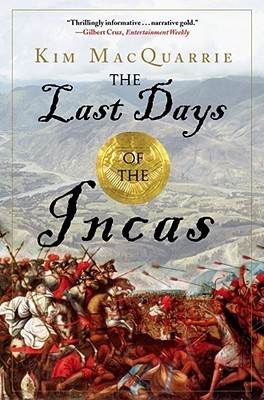
The Last Days of the Incas is an incredibly gripping read, and is definitely in the running for my favorite non-fiction title of the year. Kim MacQuarrie’s narrative style is incredibly vivid, so much so that his account of this legendary clash of civilizations reads like an epic.
MacQuarrie succeeds at bringing the Andean world to life. From the frigid highlands to the humid jungles, this book creates a truly immersive setting, allowing readers to feel like they are on adventure through Tawtinsuyu. . Similarly, MacQuarrie does an excellent job turning the participants in this historical epic into truly relatable, sympathetic, and terrifying characters. In an account of a brutal and world-historic conquest, it would have been easy to write a simple narrative in which every Spaniard is a demon and every Inca is a saint. No doubt other writers catering to modern sensibilities have written and been rewarded for writing that narrative. But what MacQuarrie presents here is so much more real, interesting, and deeply human. MacQuarrie’s Atahualpa, Manco Inca, and other Inca leaders are, on one hand, impressive, talented, and easy to root for, while on the other hand being as brutal and hubristic as their Spanish counterparts. Francisco Pizarro, his brothers, Diego de Almagro, and the other conquistadors are as greedy, callous, petty, and self-righteous as you would expect, and yet, by casting them as underdogs from Castille’s backwater facing overwhelming odds, it is difficult to be wholly unsympathetic, if only to their efforts to survive and make something of themselves in the dog-eat-dog, highly-stratified 16th century.
As rich as this book is with details of Incan civilization and the process of Spanish colonization, the best part of this book was how illuminating it was in emphasizing just how much of a tragedy the whole ordeal was. The entire story of Atahualpa’s capture played out akin to a real-world version of the fall of Troy. The extent to which one small change in the timeline would have altered the course of history for centuries is fascinating to think about. What if the great emperor Huayna Capac had not dies of small pox, triggering an empire-weakening civil war? What if Atahualpa had left Cajamarca for Cuzco one day earlier and not encountered his soon-to-be captors on that fateful day? What if Manco Inca had listened to his own advice and not trusted the Spanish? The list goes on and on. The conquest of the great Incan Empire is one of the most astounding events in world history, and The Last Days of the Incas leaves no anecdote, explanation, or primary source unexamined.
The one area where this book stumbled for me was when it pivoted away from the events of the 16th century and toward the rediscoveries of Maccu Picchu and Vilcabamba in the 20th century. I thought the rediscovery angle worked well in the introduction, but there was no reason to devote the final three chapters (almost 100 pages) to describing troubled American men trudging through the forest looking for ruins. Tonally, it was like a dramatization of The Iliad or The History of the Peloponnesian War suddenly turned into one a discount Indiana jones movie. This was a huge anticlimax after what had been a tremendous tale through the tragic fall of the Incan civilization.
Overall, this book is truly epic and gripping, and it would have been near-perfect if MacQuarrie had stopped at the end of chapter 15 with the death of the final Incan Emperor. This is a great work of history and narrative non-fiction and I would strongly recommend it.
 The Once and Future Lit