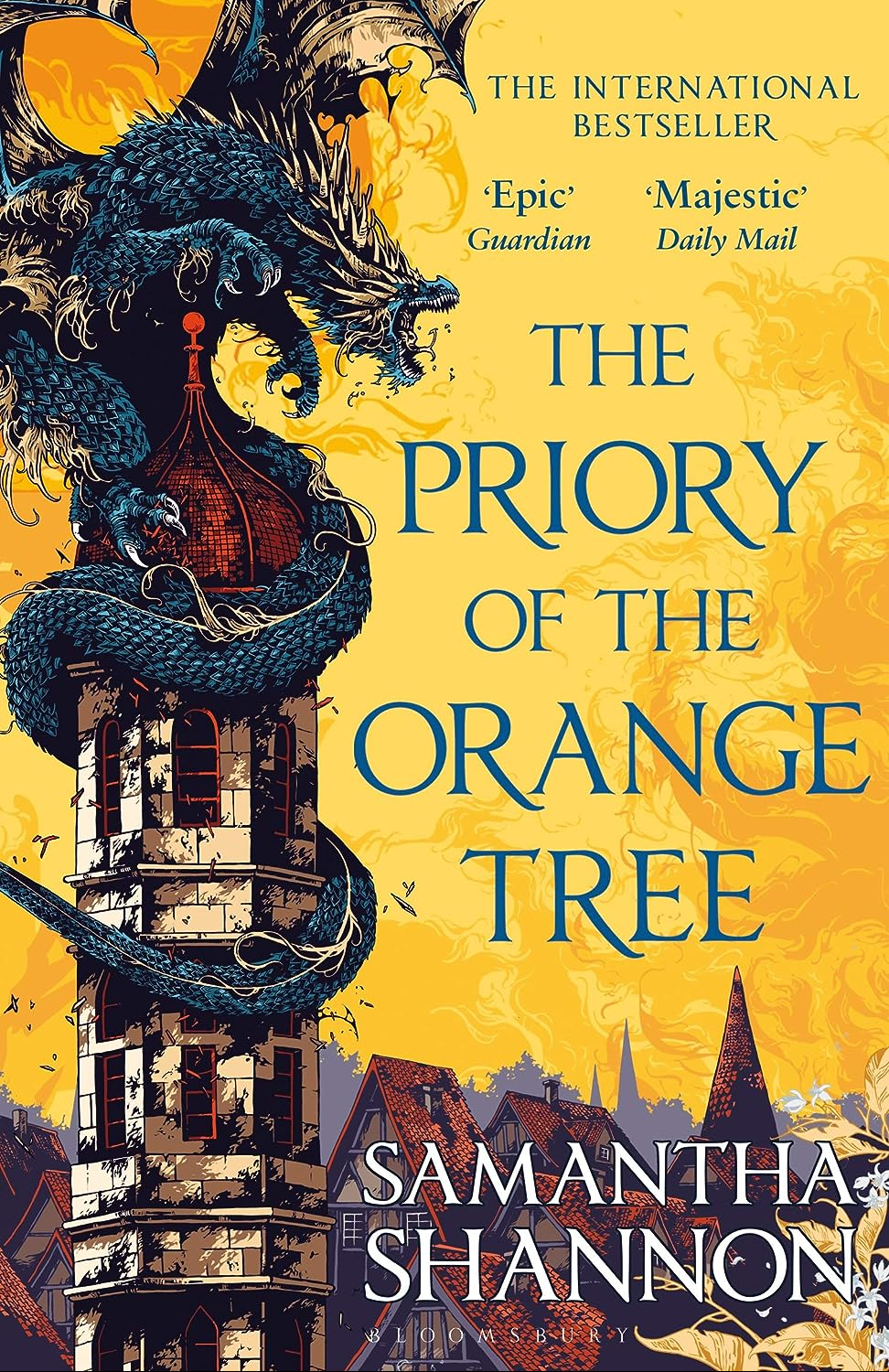
The Priory of the Orange Tree has so much to offer fantasy lovers at first glance: a single-volume epic that does not require a multi-book commitment; one of the coolest and most striking book covers on the market; and an abundance of dragons. But does it deliver?
Yes. Mostly. The Priory of the Orange Tree is a well-constructed and detailed high fantasy adventure full of worldbuilding, political intrigue, religion, and mythology. Samantha Shannon’s meticulous mapping of this fantasy world is incredibly impressive and does not feel at all derivative. While the first hundred-or-so pages may feel a bit overwhelming given the litany of characters and locations with unfamiliar names, things really do become much easier by the time the plot really gets moving. And the glossary at the back of the book is a very helpful reference aid.
Where this book really shines is in Shannon’s exploration of religion and mythology. The way in which the belief systems of Virtudom, the Priory, the Draconics, and the dragon riders of the East play off one another is great, and each is an integral part of the big picture. This book finds a way to include so many religious and fantasy tropes in a way that is original and respectful: sacred orders; divine bloodlines; ancient prophecies; lost relics; witchcraft; an immortality quest. It’s all here.
Perhaps the weakest aspect of The Priory of the Orange Tree is its characters. It pains me to say it but other than Ead and Loth, I had very little emotional attachment or investment in these characters. This was a problem given that the novel is told from four different character perspectives and each of these characters’ development, likeability, relatability, and overall relevance to the narrative is wildly inconsistent. Ead is by far the standout here, and I wish there was a more intimate version of this story told exclusively from her perspective. Loth is likeable, but he is by no means central to the plot and actually loses relevance as the pages go by. As a dragon rider, Tané should be incredibly cool, but she is not given nearly as much development as Ead, and she spends so much time separated from her dragon that I never felt the two had any kind of fondness for each other at all. Finally, Niclays Roos is just irritating and of dubious relevance to the narrative. Beyond the point-of-view characters, there are no real standouts to write home about. Queen Sabran is central to this story, and much of the narrative tension centers on the characters’ efforts to keep her alive, but she is often such an indecisive and miserable grump that I found myself wishing her ill.
A fair bit of the chatter around this book revolves around its feminist themes, gay romantic subplots, and the ethnic diversity of its characters. My biggest concern when I picked up this book was that it would fall into the trap of tokenism and forced identity politics. I can happily report this is not the case. The Priory of the Orange Tree is an exemplar of how to tell a progressive fantasy story well. There is no lecturing the reader, no jarring political messaging that breaks immersion in the fantasy world, and no tearing down of traditional archetypes to make the new ones shine. In this world, characters just happen to be of different ethnic backgrounds, some powerful organizations are run by women, and same sex relationships just exist without becoming a character’s entire identity and sole reason for existing. And none of this takes precedence over the plot, the characters’ talents and motives, and the mythology of this high-fantasy world. In fact, if you pick this book up hoping to be inundated with present day American social justice messages, you may actually be disappointed.
While this book was originally supposed to be a one-off project, I am glad Samantha Shannon decided to continue writing stand-alone novels in this world. I look forward to reading the prequel, A Day of Fallen Night, which is set centuries earlier during the Grief of Ages mentioned in The Priory of The Orange Tree, and which promises to be even heavier on the politics and mythology of this world.
 The Once and Future Lit