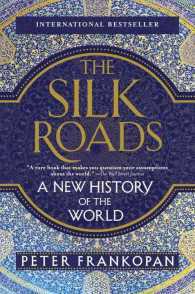
Peter Frankopan’s The Silk Roads is a truly impressive “new history of the world” in that it effectively accomplishes its main objective: retelling world history with a focus on the heart of the Eurasian landmass, where East and West collide. This book does an excellent job carrying readers across thousands of miles and through thousands of years of history to make a compelling case for how globalization, cultural cross-pollination, and the tension between East and West have been the fulcrum of human history, economics, and geopolitics since the beginning.
The Silk Roads begins incredibly strong. The early chapters focus heavily on the movement of religion and philosophy between East and West, and highlights of these chapters included a concise explanation of the rise of the world’s great religions, the way Greek and Buddhist philosophy mingled in the ancient world, and the way in which religion played heavily in medieval politics, economics, and warfare in Europe and the Middle East during the Islamic conquests and the Crusades.
The book then transitions to having a more overt focus on trade and economics as it enters the period of European colonization and exploration. While European settlement of the Americas is well-covered ground, Frankopan offers fresh emphasis on how the the initial voyages and subsequent extraction of resources such as silver and gold were heavily motivated by European nation states’ interests in the East. This thread is carried throughout the remainder of the book in Frankopan’s discussions of the discovery of oil in the Middle East, the World Wars, and the Cold War. All the familiar beats are there, but are repackaged through the lens of viewing world history as a constant imperial tug of war over the strategic resources and lands of the silk roads. Finally, it is worth noting that this book went above and beyond in its explanation of the creation of the modern Middle East, from the Iranian Revolution to the Taliban in Afghanistan. This means that the book ends up having a much greater focus on the twentieth century than readers may expect based on the synopsis.
One critique of this book is that I was hoping for more coverage of China and India. While I understand Frankopan’s emphasis was on covering the space between East and West, the space given to these two great Asian civilizations is significantly less than the space given to the role of Europeans and Americans in the history of the Middle East and Central Asia. I would also note that despite this book’s already thick spine, I would have enjoyed more maps throughout the book (minimum one per chapter), particularly because Frankopan is zooming in and out of an immense area as it changes over time.
Overall, I highly recommend this book to readers looking for a crash course in many of world history’s greatest hits (world religions, the Greeks and Romans, the Crusades, the Mongols, the Age of Exploration, the World Wars, the Iranian Revolution, American foreign policy in the Middle East) but who are open to viewing events and motivations from a different angle than they may be used to. I really wish I had annotated my copy of this book because there were so many great excerpts and facts that I will not possibly remember them all. I look forward to reading more of Frankopan’s work in the future.
 The Once and Future Lit