
Wolf Hall is a rich and incredibly well-written novel, and Hilary Mantel deserved the many awards and praises heaped on this novel. It truly is an exceptional feat of historical fiction and I challenge any reader to argue that Mantel did not have a masterful grasp on the English language. I hope that Wolf Hall remains highly regarded not only as a novel, but as a true work of literature.
In many ways, reading Wolf Hall reminded me of reading Dickens: the playful language, the moody protagonist coming of age and crossing class boundaries, a dangerous England home to both charming frivolity and the ghosts of the dead. But oddly enough, despite being a twenty-first century work, it was a more difficult read. This is where my biggest issue with Wolf Hall kicks in. The third person limited point of view was a bit of a struggle. For the first hundred-or-so pages, I found Wolf Hall slow and confusing to follow. I constantly re-read passages to decipher who the “he” Mantel was referring to was in many dialogues. This was made even more challenging given that in the novel’s Tudor setting many conversations referenced characters with shared names (Henry, Anne, Mary, and of course Thomas). The novel also is not a linear narrative, as Cromwell often describes memories from his childhood and other past events, so you will have to pay attention to be sure exactly where you are in place and time. It is also worth noting that I picked up Wolf Hall already knowing a lot of the history covered, and so I can easily see readers unfamiliar with the period really struggling to keep up with all the different characters, their titles and relationships, the political and theological issues, and even the relevance of the book’s title. For example, if Mantel referring to Henry VIII’s best friend Charles Brandon the Duke of Suffolk as Charles, Brandon, Suffolk, the Duke, my Lord, and his Grace at different points with no prompting or hand holding sounds unappealing to you, then you may struggle with Wolf Hall. Never have I been more grateful to an author/publisher for including a cast of characters reference list in a book.
If you do your Tudor homework and get used to the narrative style however, Wolf Hall is a real treat. Give Mantel the reins and she will take you on a ride through the consciousness of Thomas Cromwell, one of history’s most fascinating power players. Mantel’s Cromwell is equal parts lovable and detestable, humorous and heartless. The way she plays with the English language and history is sure to bring a smile to history and literature lovers – again, evoking the talents of Dickens, and even Shakespeare.
If you studied Henry VIII in school or watched The Tudors and want to really dive into this time period in a way that is challenging but ultimately rewarding, then Mantel’s work is definitely worth it. If you’re interested in the sexy drama of the Henry VIII story with a heavy focus on seduction, romance, and betrayal, Wolf Hall is not for you.
All said, I enjoyed Wolf Hall. It was not as “fun” or gripping as I had hoped it would be, largely due to Mantel’s stylistic choices, but it’s a trade off. You can read or watch Anne Boleyn’s rise and Henry’s eccentricities elsewhere, but only Wolf Hall will give you Tudor history through Cromwell’s eyes with true literary flair and depth. Now that I’ve acclimatized to Mantel’s work, I’m hoping to really love the next installment in this trilogy.
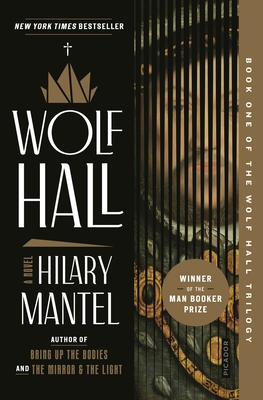
Wolf Hall, Hilary Mantel
 The Once and Future Lit