
I have read and reviewed twenty-nine books since I last dished out a two-star rating, but as the Good Book says, “to everything there is a season, and a time for every purpose under heaven,” so here we are.
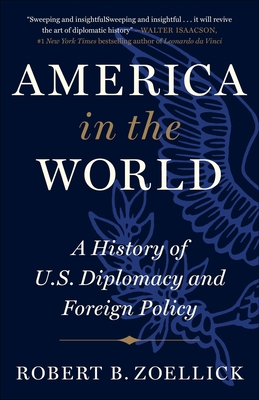
What a disappointing book. You would think that a book titled America in the World: A History of U.S. Diplomacy and Foreign Policy, written by a former deputy secretary of state, U.S. trade representative, and President of the World Bank would be overflowing with novel insights, complex analysis, and an appreciation for how systems, ideas, and institutions propel history. Unfortunately, this is not that book. In the introduction, Robert Zoellick claims that this sweeping history of U.S. foreign policy and diplomacy will be framed by five traditions: 1) the importance of North America; 2) the roles of trade, technology, and transnational relations; 3) alliances and connections with other states; 4) the need for public and Congressional support; and 5) the belief in American policy serving a higher purpose. This is not how this book is structured at all. These themes are buried so deeply in the text that they do not emerge again in any organized way until the conclusion chapter. Rather, the top-line of the blurb at the back of the book explains this book’s approach best: “Ranging from Benjamin Franklin, Alexander Hamilton, and Thomas Jefferson to Henry Kissinger, Ronald Reagan, and James Baker, America in the World tells the vibrant story of American diplomacy.” In other words, from the founding fathers to the patron saints of neoconservative Republican politics, this book is a plodding chronological account that overwhelmingly pushes a traditional “great man” theory of history, in which the story of American diplomacy is really the story of individual presidents’ and cabinet secretaries’ personalities and styles.
I picked up on Zoellick’s approach very quickly, and while I found it disappointing and inadequate, I was still able to appreciate his work for what it was for much of the first half of the book. The big problem with this book comes in as readers get closer and closer to the period in which Zoellick himself served in the foreign policy establishment. As you read this book, you will quickly notice the snowballing frequency of namedrops of Zoellick’s bosses, George H.W. Bush and James Baker. While Woodrow Wilson, Franklin Roosevelt, John Kennedy, Richard Nixon, and Ronald Reagan all get their dues, this book would reasonably have you believe that the American Presidency, American power, American greatness, and American genius peaked during the one-term presidency of George H.W. Bush. Zoellick makes sure to let readers know that not since John Adams and Thomas Jefferson has the American Republic been so blessed by a pair as close and competent as Bush and Baker, and that many of twenty-first century America’s foreign policy wins have been rooted in the approach taken by George H.W. Bush.
I wish I had not taken Zoellick’s impressive resume at face value before picking up this book. After eight years of living and working in Washington, DC, shame on me for not realizing that this is one of those books that is probably devoured and gushed over at think tank events, but has little constituency elsewhere. Rather than being a book about the history of U.S. diplomacy and foreign policy, this is a cherry-picked collection of stories about presidents who led the country during the wars we all know very well, and a pseudo-memoir that pines for the good old days when neo-conservatives dominated American foreign policy in the 1980s, but before the chickens came home to roost in the decades that followed. The chapter on Ronald Reagan was truly the point at which I stopped taking this book seriously. Across twenty-five pages, Zoellick regurgitates the tired narrative that “the Great Communicator” basically ended the Cold War with the power of his rhetoric, and calls Reagan a “romantic” at least six times. And yet there is but one throw away sentence in the final paragraph of the entire chapter that mentions Iran-Contra. There is no mention of anything related to Reagan and the CIA’s activities in Latin America at all. Zoellick’s sanitization here made me doubt the credibility of the narratives he presented in the earlier chapters that covered history I was much less familiar with.
For a book with this title published in 2020, Zoellick’s work also feels incredibly incomplete. With the exception of a brief conclusion with a sub-section titled “Four Presidents,” this book ends with the presidency of George H.W. Bush and the end of the Cold War. The entire Clinton, W. Bush, Obama, and Trump presidencies are covered in less detail than you could find on Wikipedia, and there is absolutely no reckoning at all with American foreign policy in the twenty-first century other than Zoellick offering his rushed takes that essentially Clinton copied the almighty George H.W. Bush, George W. Bush became a wartime president because he had to, Obama was smart but weak, and Trump does not respect traditions and alliances. Zoellick unconvincingly claims that he could not properly grapple with recent presidents’ legacies because we are still sifting through everything that happened and that the politics are too close. Well, concerns about politics didn’t stop Zoellick from building an altar to Reagan and Bush while eviscerating Lyndon Johnson and essentially wiping poor Jimmy Carter from history. Call me crazy, but I imagine, like his fellow Bush-era alumni, Zoellick just could not bridge the chasm of cognitive dissonance between the mythology he tells himself about the 1980s and actual damage neoconservative foreign policy did to the country and the world through the failed wars in Iraq and Afghanistan that ended countless lives, wasted trillions of dollars, embarrassed the country, and discredited the entire Republican Party establishment, leaving the door wide open to the angry populism of Donald Trump.
Off the top of my head, in addition to the entire twenty-first century to date, here are a few major topics in the history of American foreign policy and diplomacy that this book does not tackle at all: the development and evolution of the modern national security council; the development and professionalization of the State Department and the foreign service; USAID, the Peace Corps, and international development; the U.S. role at the United Nations; the evolution of America’s special relationship with Israel; international energy policy and relations with Saudi Arabia and other OPEC states; U.S.-China relations after Nixon; America’s efforts at regime change in places like Iran and Chile.
In sum, if you want to read a history of U.S. foreign policy, there is no reason to pick up this book if you have access to George Kennan’s classic American Diplomacy or Walter McDougall’s Promised Land, Crusader State: The American Encounter with the World Since 1776. Both of those books are much more concise, informative, sophisticated, and thought-provoking.
 The Once and Future Lit