
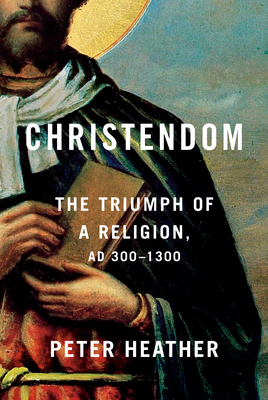
Peter Heather’s six-hundred-page chronicle of Christianity’s rise from a niche cult in the Eastern Mediterranean to center of religious, cultural, and political life across the European continent by the year 1300 is an excellent read for those interested in the rise of one of the world’s great religions, the making of the West, and the transition from the Roman world of antiwuity to the high middle ages. There is an incredible amount of detail packed into every chapter. So much so that I worry I will forget some of the fantastic and important points Heather includes. Luckily, Heather does an excellent job re-stating the key points and conclusions at the end of each chapter and structuring the book in three main sections.
The first portion of Christendom chronicles the rise of Christianity in the Roman world and charts how the small, loosely organized group of Jesus’s followers came to upend life and faith in the Roman state. Constantine’s conversion is presented as an inciting incident that triggered a top-down conversion born out of politically-expedient decision-making on the part of the Roman elite classes who angled for status, access, and proximity to the in-vogue beliefs of the imperial court. Once the land-owning elites had converted and agreed upon a governing Nicaean Creed, the mass-adoption of Christianity by the masses was a fascinating blend of iconoclasm that saw the destruction of the polytheistic pagan traditions of the Greco-Roman world and the Near East, blended with a cultural symbiosis, in which pe-Christian gods, traditions, and practices eventually found their way into the Church.
Part two charts Nicaean Christianity’s rocky survival through the mid-first century CE, as the Western Roman Empire crumbled, Islam rose as a formidable competitor and threat that swallowed up the ancestral Christian heritage sites and hubs in the Near East, and the religion itself fought find its footing in the newly-decentralized former Western Roman provinces and the the yet-to-be converted wilds of Anglo Saxon northwestern Europe. Once again, Christianity found away to make its teachings and perks appealing to diverse groups. To the Anglo Saxon kings, Christianity was framed as the religion of warriors and the literacy and written records of the Church offered a new form of immortality for proud rulers.
Finally, Part three explains Christianity’s reinforcement and solidification in the early centuries of the second millennium CE. The successes of Charlemagne’s Frankish Kingdom and the birth of the Ottonian Holy Roman Empire brought imperial, Christian kingship back to Western Europe for the first time in centuries. As the same time, these powerful, well-resourced kingdoms used their influence to fund and lay the groundwork for a new age of Christian philosophy, learning, and orthodoxy. The papacy itself, through royal patronage, the fortuitous successes of the First Crusade, and the increasing deference given to popes as divinely-annointed rulers with power apart from secular kings all aided the creation of a monolithic Christian super-entity that spread across the European continent, largely able to enforce its canon and dictates through the hiring and promotion of clergy, the establishment of parish churches, bishoprics, and monastic houses that spread Christian values to the local laity, and through no shortage of warfare, inquisitions, and financial threats.
In Christendom, Heather really illustrates that understanding why people believe what they believe is never simple, especially on a societal scale. Religion appeals to a fundamental metaphysical human curiosity, but it is also a compromise; a negotiation between orthodoxy and reforms, the old and the new, the spiritual and the pragmatic.
The biggest downside here is that if the minutiae of theological doctrinal debates and the names and summaries of dozens of individual Roman and medieval notables mean little to you, you may get a bit lost in the walls of text and lengthy chapters. There were some chapters where Heather’s focus did not seem to align with the parts of this historical phenomenon that I was interested in spending time on. There is also very little hand-holding here. If you don’t already come to this text with a decent understanding of Roman and medieval Europe, and key Biblical events and Christian beliefs then you may struggle. I would definitely suggest picking up a couple more accessible history books about this period before reading Heather’s chronicle of Christianity’s one-thousand-year journey toward triumph.
 The Once and Future Lit