
After two highly ambitious novels, Dan Simmons puts the Hyperion Cantos on cruise control.
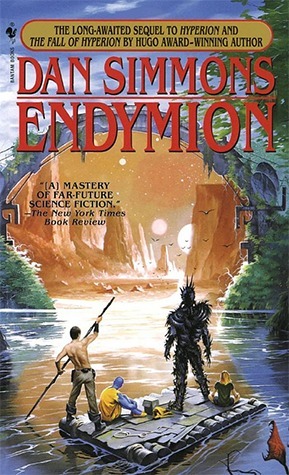
Upon finishing The Fall of Hyperion I considered whether it would be better to go directly into the Endymion duology, or take a break from the Hyperion Cantos after the first duology and return to the latter two books at a later time. My biggest concern was that The Fall of Hyperion was so dense that I feared burn out. Luckily, this was not an issue in Endymion. The third novel in the Hyperion Cantos offers yet another drastic shift in narrative tone and structure. Compared to its two predecessors, Endymion is a relatively simple read and there is almost nothing added in terms of world-building. It is very much Dan Simmons’ take on a traditional episodic adventure story. Raul Endymion is a pretty unremarkable protagonist, but his youth and inexperience make him a very different narrator than the wise, experienced protagonists of the first two books. And starting the book off with the tragic death of his dog really got to me. The android companion, A. Bettik is a nice sidekick but never really reaches his thematic potential. Aenea was definitely my least favorite character. She reminded me a lot of Alia from the Dune books: a human child infused with knowledge and intelligence beyond her years that makes her deeply unrelatable and which sometimes leads to gross sexual insinuations that I really don’t want to read coming out of a twelve-year-old’s mouth even if she has the mind of an adult. The best characters are definitely Father Captain De Soya and, dare I say, the ship. De Soya (particularly in the first half of the novel) makes for an excellent villain: the ideologically-driven priest and ship captain who hunts our heroes across the galaxy. His loyalty to the Catholic Church and getting to witness his multiple deaths and resurrections thanks to the cruciform are very reminiscent of stories of crusaders and eighteenth-century pirate captains. And the ship is just a ton of fun: the classic “know it all” robot voice that the human characters sometimes have to tell to shut up.
Overall, the formula Simmons came up with for Endymion was a good one. For the most part, this is a book in which our heroes row down a river that spans many different worlds and is connected by interplanetary portals, as they try to outrun their pursuers to the final destination. The problem is that it became way too repetitive and started to drag. The first couple times our heroes “farcasted” to a new planet, it was great. The ocean world of Mar Infinitus with its poachers, multicolor sharks, and ill-fated espionage story was a highlight. But the later worlds, especially the ice world of Sol Draconi Septem was an unfortunate drag.
I would consider Endymion more of a Hyperion spinoff than a true sequel. If you really loved the first two books then it’s worth reading, but I can definitely respect those who see The Fall of Hyperion as a good place to get off the river raft. My understanding is that Endymion is generally seen as a the weakest of the four books, and that The Rise of Endymion wraps the entire Cantos up with a phenomenal ending. Hopefully that’s true and Endymion was more of a laid-back interlude between the heavy hitters.
Endymion, Dan Simmons
 The Once and Future Lit