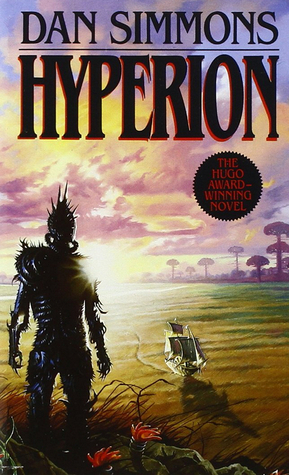
This was easily one of the best reading experiences I have ever had, and before I even finished it, Hyperion skyrocketed high onto the list of my favorite books of all time. This is the kind of book that feels like it was written with my exact tastes and interests in mind, and Dan Simmons truly impressed me with how masterfully well-written this book is.
Hyperion is often referred to as a science fiction take on the Canterbury Tales, in which a group of seven pilgrims journey to the planet Hyperion to seek an audience with a being known as the Shrike. Who or what is the Shrike? Nobody knows. Some refer to it as the Lord of Pain; others a deity; others a monster. Some worship it; all seem to fear it. All we know is that this four-armed, spiked, chromatic, creature with glowing red eyes lives amongst the Time Tombs on Hyperion. In an effort to understand the greater purpose of their pilgrimage and why each of them was chosen for this voyage, the pilgrims each take turns telling their backstories to the group. This means that Hyperion largely plays out as a series of short stories/novellas with the broader journey to the Time Tombs interspersed.
One of the most impressive and coolest things about this novel is the way Simmons successfully tells each character’s tale in a unique voice, style, and genre. A great writer would be proud to have written any one of these, but the fact that one man wrote all seven with such consistent quality, richness, and depth honestly made me jealous. Within this one novel, readers are treated to cosmic horror, space warfare, incredibly graphic sex and violence, a detective story, heartbreaking tragedy, comedy, espionage, poetry, and incredible riffs on morality, fate, and justice. To achieve this, Dan Simmons displays a grasp of human history, science, religion, literature, and politics that I’ve rarely (if ever) seen one author display in one novel. The Lord of the Rings and Dune are the only rivals I can think of.
While I enjoyed each of the pilgrims’ tales (as well as the overall narrative), I can definitely rank them, and I imagine each reader will have a different list based on their individual genre and style preferences:
1) The Scholar’s Tale (The River Lethe’s Taste is Bitter): This one was devastatingly sad. I don’t want to spoil anything here, but this story of the Weinstaub family will definitely pull on your heartstrings. It features a particularly painful portrayal of incurable illness that will resonate with anyone who has witnessed a loved one slowly succumb to cancer, dementia, or other chronic illnesses. On top of that, the story is truly enriched by Simmons’ take on the biblical tale of God testing Abraham by demanding he sacrifice his son.
2) The Priest’s Tale (The Man Who Cried God): This was the first of the pilgrims’ tales told in Hyperion and it was an incredible place to start in terms of setting the tone and world-building. This story offers readers their first look at the planet of Hyperion and their first encounter not only with the Shrike, but with other strange, otherworldly entities. An exploding forest; a strange indigenous population; a parasite; musings on the state of Christianity in the far-future and the nature of death. It’s all here and it’s all incredibly weird. This is cosmic horror to rival H.P. Lovecraft. While Father Hoyt is the pilgrim narrating the tale, it is really the tale of his fellow priest, the exiled Father Paul Duré, and is mostly a relaying of Duré’s time on Hyperion told through his diary entries in an epistolary form reminiscent of Bram Stoker’s Dracula.
3) The Poet’s Tale (Hyperion Cantos): The poet, Martin Silenus, is definitely one of those “love him or hate him” characters. He is irreverent, often unserious, and truly irritating to some of his fellow pilgrims. His tale also takes on the most light-hearted tone of the bunch. In it, Silenus, a centuries-old man out of time explains his rise in the literary world and how his refusal to comply with the death of literature in a culture hooked on fast, shallow, instant entertainment (sound familiar, anyone?) led him to the court of Sad King Billy, the bumbling, cartoonish, stuttering heir to the British Monarchy who ultimately takes it upon himself to establish and patronize a colony of poets and artists on Hyperion. I absolutely loved and related to Simmons’ anxieties about the future of art and literature in this story. The opening paragraph alone says it all: “In the beginning there was the Word. Then came the fucking word processor. Then came the thought processor. Then came the death of literature. And so it goes.”
4) The Consul’s Tale (Remembering Siri): This one really packs a lot in. Like the Priest’s Tale, a significant portion of Consul’s Tale is actually relaying someone else’s story, this time played back on a recording. This recording tells the love story of Merin, a sailor in the service of the Hegemony of Man (the intergalactic human empire of connected worlds) and Siri, a young girl from one of the few unspoiled planets to not-yet come under Hegemony rule. Because of the nature of how time moves differently across the universe, Merin’s visits to Siri’s world come mere months apart for him, but roughly a decade apart for her. As such, he watches her age and live a lifetime, while he remains young. The love story itself is great, but where this really shines is in its commentary on colonization, and how the benefits and conveniences of modern life often come at the cost of natural beauty, conservation, and cultural traditions. Given this novel’s age, this story is on of the best examples of Hyperion being very much ahead of its time. As final of the pilgrims’ tales told, this story also does a lot to clarify and contextualize the technologies, politics, and stakes scattered throughout the main narrative and the earlier stories.
5) The Soldier’s Tale (The War Lovers): This story contains one of the most jaw dropping “what the fuck did I just read?” climaxes I have ever read. In this tale, Fedhman Kassad is a soldier who trains by engaging in simulated re-enactments of great battles from human history, such as Agincourt and The Somme. While on the field at Agincourt he encounters and falls in love (very, very quickly) with a woman named Moneta. Moneta continues to appear to Kassad across simulated time, and in his waking life he obsesses over whether she is even real. This story may be the most polarizing of the bunch, but my only real gripe with it was actually during the space battle. This was one of the few parts of the novel where I felt a bit overwhelmed by the science fiction jargon at times.
6) The Detective’s Tale (The Long Goodbye): Brawne Lamia is the only woman (excluding Rachel) among the pilgrims, and her tale starts off as a traditional “who done it” detective story with one key twist: the murder “victim” is an artificial intelligence named Johnny. This story is Simmons’ deep dive into the nature of artificial intelligence and the key themes and questions are incredibly prescient in 2024. Can artificial intelligence die? Can it fall in love? Is an AI reconstruction of a human being’s consciousness the same as the original human? What happens with AI entities develop political factions based on their disagreements on whether/how to interact with humans? This is all incredibly fascinating and despite being my least favorite of the tales, this is still excellent. The ending just felt a little bit overshadowed by similar ideas presented earlier in The Scholar’s Tale.
While I cannot recommend Hyperion strongly enough, and I will be talking and thinking about this book for a long, long time, I can accept that it may not be everyone’s cup of tea. Simmons definitely does not engage in hand-holding here. The science fiction terminology is very heavy in the prologue, but I strongly suggest readers not let that intimidate them. The more you read, the more things will fall into place, as each of the tales revists and explains the key concepts at the right time. This book is also overflowing with references to literature, religion, philosophy, history, and mythology. In particular, Hyperion is overflowing with references to the poet, John Keats. If you know Keats’ life and work, I imagine this will add a lot to your reading experience, but as someone who knew nothing about Keats before starting this novel, it definitely did not detract from my experience. If you, like me, are familiar with the Bible, Norse Mythology, and world history, then I promise you there are so many exciting and brilliant references in this book. For example, a group known as the Templars are devoted to ecological preservation and travel the galaxy on giant World Tree ships, one of which is named Yggdrasil; and there is a New New York Times bestseller list because there is a city somewhere called New New York because the old New York did not survive the destruction of Old Earth.
What more can I say? I love this book and I cannot wait to see what happens to the pilgrims and get kore answers in The Fall of Hyperion.
 The Once and Future Lit