
“When the Moon rose in the Third Northern Hall I went to the Ninth Vestibule
-Entry for the first day of the fifth month in the year the albatross came to the south-western halls”
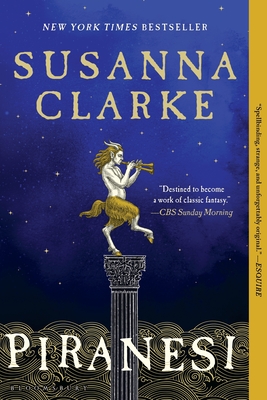
From its very opening lines, Piranesi is pure mystery and magic. It is a perfect balance between art and entertainment. In so many ways, this book exemplifies a “less is more” philosophy. Published fifteen years after her previous novel, Susanna Clarke’s Piranesi is a tight 350 pages in which every word feels intentional. While many things are left vague or unexplained, nothing feels phoned-in, under-baked, or rushed. Instead, the ambiguity in this novel leaves so much space for readers to theorize and interpret long after they’ve finished reading.
And yet, for all its simplicity, Clarke manages to depict a well-realized world and rich characters. I don’t know how she managed it, but it took only a few pages before I had developed a full mental image of the House, complete with the smell of the sea, the crashing of waves, the sounds of birds, and the stone and shadows of the infinite statues and walls. The House is at once beautiful, haunting, scary, and majestic, and I imagine that readers will disagree on whether it feels like heaven or hell; sanctuary or prison.
Similarly, Clarke works wonders in bringing the character or Piranesi to life. Without a doubt, Piranesi is one of the most interesting characters I have ever encountered in literature. The entire novel (a few journal entries aside) is narrated from his perspective, and we are privy to his every thought and feeling. We follow him through his daily activities in the House, and he learns more and more about the world, the Other, 16, and himself, we are on that journey with him. In many ways, he is like a child; innocence embodied, and I found myself wanting to befriend him and give him a hug. There was something really pure and sweet about observing a character derive such genuine joy from simple acts like talking to birds, caring for skeletons, journaling, fishing, meticulous record-keeping, exploring, and putting shells and beads in his hair.
The plot of Piranesi is a mystery, and given the epistolary style, we see Piranesi react to revelations in real-time. As such, the reading experience evolves as the novel progresses. While the first few chapters are disorienting, confusing, and simple, information and connections quickly form as Piranesi’s knowledge expands. Reading this book is like unwrapping a gift.
I strongly recommend giving this book a try, but I understand that it won’t be for everyone. It can be very abstract and ambiguous. If you’re the type of fantasy reader who is looking for epic storytelling and action, then you may not like Piranesi. But I’d suggest giving it a try anyway. Chances are, no matter what type of reader you are, you’ve never read a book quite like this.
 The Once and Future Lit