
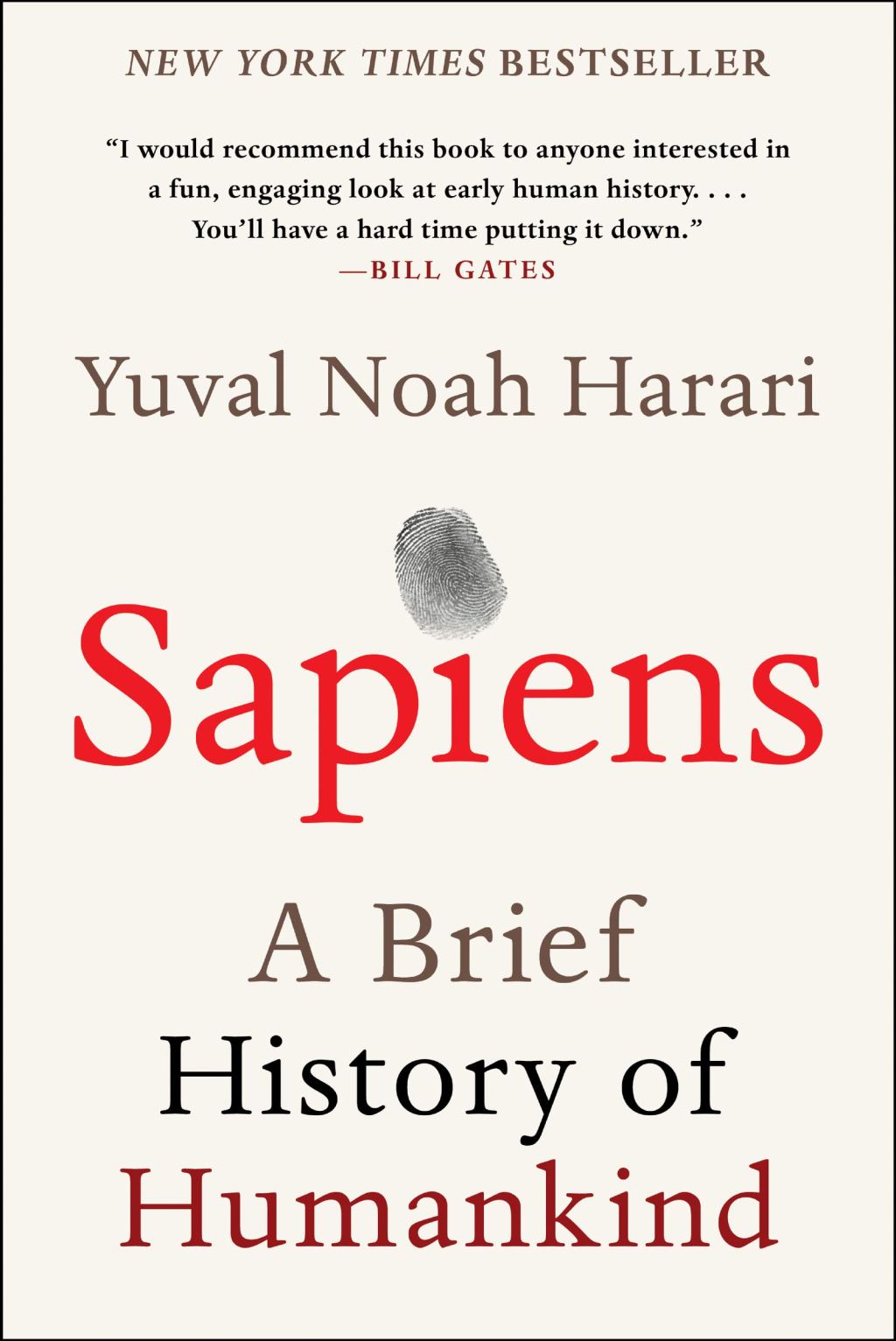
Sapiens is one of the most well-written, engaging, and interesting interpretations of human history I have ever read. Yuval Noah Harari strikes a great balance between introducing critical historical events and concepts (such as the agricultural revolution, the foundation of world religions, the scientific revolution, the industrial revolution, and the European encounter with the Americas and the age of imperialism) on one hand and philosophizing on where we have been, where we are, and where we are going as a species on the other.
One of the things I most enjoyed in Sapiens may be something that turns other readers off. Harari’s realist, detached approach can come across as challenging (or even flat-out negative) toward many ideas, institutions, narratives, and values that people across the political spectrum and from any number of cultural traditions hold dear. I can easily see a contemporary American young progressive socialist snapping their fingers and nodding along to Harari’s comments on gender and religion on one hand, and then wanting to cancel him the next for his defense of imperialism and capitalism. Similarly, white supremacists who see the history of western civilization and as vindicating their claims, will be crushed under the fluency in which Harari explains how the science, technology, and ideologies of today’s world are the product of multicultural contributions across thousands of years, and that, in the grand span of human history, Western European wealth and dominance is little more than a blip.
I doubt there are many people who would agree with every word Harari has to say, but he is incredibly skilled at presenting compelling theories of history, and forcing any engaged reader to grapple with their preconceptions about history, morality, and even the meaning of life. Sometimes, Harari pushes a little too far, and his arguments stretch believability (for example, his suggestion that humans have actually been domesticated by wheat because wheat is now the most dominant crop on earth and the agricultural revolution actually boxed humans into confinement in the form of houses and cities in service to our master, wheat), but overall his challenges are incredibly compelling to engage with. Are secular modern humans as religiously devoted to and ensnared by capitalism, communism, and technology, as our predecessors were to Christianity, Islam, or Hinduism? Is our treatment of livestock as great a moral failure as our treatment of slaves in prior civilizations? Is genocidal violence and the extermination of other species inseparable from the human experience going back to the extermination of neanderthals, homo erectus, and other human species? Do any of our actions, feelings, or desires have meaning outside of our biochemistry and the inter-subjective myths we tell ourselves about good and evil, the meaning of life, the value of money, or the importance of the cultures and societies in which we live? What is the point of more wealth, more knowledge, better healthcare, and more advanced technology if there is no certainty that humans today are any happier than their ancient ancestors? Will we bring about the end of homo sapiens by using technology to turn ourselves into something else entirely?
Harari offers his answers to some of these questions, but also isn’t bold enough to claim that he – or anyone else – can answer them all. This makes Sapiens incredibly engaging to read, the ideas within it compelling to discuss and debate with others, and the uncomfortable truths and theories pretty worrying to contemplate.
 The Once and Future Lit