
Spoiler warning.
“[In] the end – when all else is dust – loyalty to those we love is all we can carry with us to the grave. Faith – true faith – was trusting in that love.”
In my review of Hyperion, I was very clear that I adored pretty much everything about that novel. I don’t feel anywhere near as strongly about The Fall of Hyperion, but I still think this sequel deserves a tentative five-star rating.
This book is nothing if not ambitious. Dan Simmons crams in five-hundred pages of overwhelmingly detailed science fiction world building, philosophy, action, politics, revelation, and solid action scenes ranging from hand-to-hand combat to world-ending nuclear destruction. As promised, each of the pilgrims from the first novel is given closure here, but some are far more well-developed, emotionally impactful, and relevant to the plot that others. Despite the length of The Fall of Hyperion, many chapters will pass where readers do not check in with the original cast of characters we grew to love in Hyperion.
This leads to my biggest criticisms of this book: the narrative structure and the disproportionate attention paid to the two new point-of-view characters (Meina Gladstone and Joseph Severn/John Keats/the cybrid). The inclusion of Gladstone’s perspective allows readers to see inside the war room and behind the curtain of Hegemony politics, but there is just way too much of it. The Fall of Hyperion includes several Gladstone chapters/sub-chapters that amount to a group of politicians and military advisors sitting around discussing the minutiae of inter-planetary battle plans. If I’m being honest, it sometimes felt like homework to keep up, and I’m not sure that I always did. The Severn/Keats chapters are not nearly as difficult, but on the whole could not live up to how enthralling the pilgrims’ stories were. I’m not sure why, but I imagine the fact that the character is a cybrid artificial intelligence reconstruction of a real-world poet rather than a purely original and human character probably had something to do with it.
Now on to the things that still make The Fall of Hyperion a captivating accomplishment. The pilgrims remain as incredible as ever. Martin Silenus’ encounter with The Shrike in the dead city as he tries to finish his cantos was horrific and the Shrike’s tree of pain is the actual stuff of nightmares. Kaddad’s quest to kill Moneta and The Shrike doesn’t get anywhere as graphic as his encounters in the last book did, but this story offers great action scenes and a real hero’s tale. We finally learn what happened to the missing pilgrim, the Templar Het Masteen in the previous book. Brawne Lamia’s trek with Silenus is very entertaining and her journey into the networks artificial intelligence to learn about the Core and its objectives from a powerful AI named Ummon is one of the most interesting and smart scenes in this book. The parasite-cursed priest, Father Dure (mostly taking over for Father Hoyt) does a lot of hopping around to different places and interacting with different religious and ideological factions. His conversations with the leaders of the Shrike Cult and the Templars and the devastation he witnessed at God’s Grove were a well-written portrayal of men having their faith tested to the core. The Consul wrestles across this novel with what it means to be loyal and what it means to atone for past failures and betrayals. Through his journey, readers get to finally meet the Ousters, and they are a very cool depiction of one possible future for human evolution. And Sol Weintraub. Wow. Sol is the best character in the Hyperion duology, and his story is just as perfectly written. Dan Simmons really went all-in on writing the story of a man absolutely driven by his love for his daughter and willing to make the most painful decisions over and over again. This is a parable of faith, love, and hope in which a man goes so far as to offer his child to a monster in the hope she may be saved. What ultimately becomes of Rachel genuinely surprised me (though others may see it coming).
When I got to the end of The Fall of Hyperion, I confess I was still a little confused about the details of what I had just read, and I am still not sure I feel 100% satisfied by the ending. The final confrontation with The Shrike was a bit confusing in such a way that it seems like Simmons left it open to interpretation. As I already mentioned, the extensive descriptions of fatline casters, deathwands, and dozens of other technical terms a bit overwhelming, but the substance of what Simmons explores here is awesome and absolutely ahead of its time. The way he portrays the different factions of the TechnoCore was something I had not encountered before. One AI alliance wants to protect humanity in much the same way humanity feels a fondness for trees. Another seeks to destroy humanity in the way humans destroy any other species that threatens its dominance. A third seeks to create the Ultimate Intelligence (an all-knowing being) that can be the true arbiter of humanity’s fate. Simmons also projects the most basic dilemmas in war and morality into the future. Echoing the bombing of Hiroshima, he has characters wrestle with whether it is worth killing millions and destroying a civilization if it would mean saving billions. Others are so welded to their religions and ideologies that they gamble their lives and the survival of their worlds on the promises of prophecies.
Whether you enjoy this book and certainly whether you enjoy it as much as Hyperion will likely depend on which book’s narrative structure and style you prefer. They are very, very different and my preference is clear. That said, while I missed the more character-focused, intimate storytelling of Hyperion, I completely respect how well Dan Simmons juggled so many moving pieces and ideas in this sequel. For all it’s complexity and density, The Fall of Hyperion remains a smooth read if you just stick with it and give yourself permission to not fully understand every little detail. This is the kind of book where there will surely be themes, references, concepts, and happenings that you miss the first time around. While Simmons answers many of the lingering questions by the final page, there remains a solid box of unsolved mysteries that I am sure have fuelled countless fan, book club, and internet theories and debates for decades.
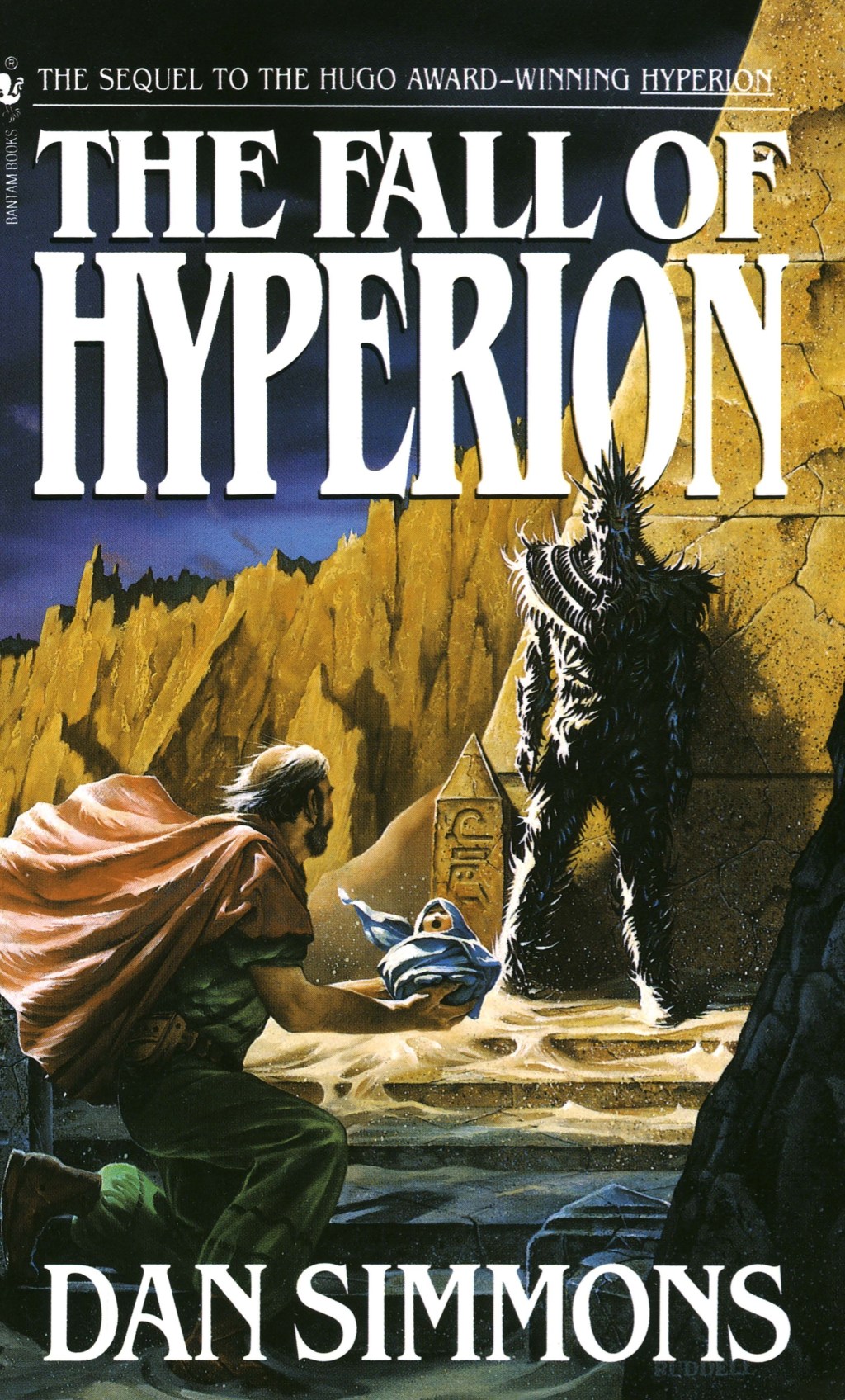
The Fall of Hyperion, Dan Simmons
 The Once and Future Lit