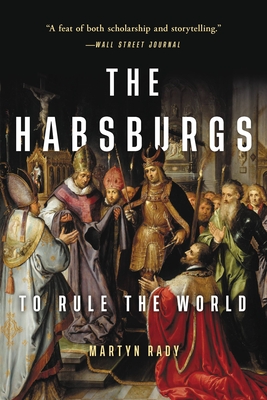
Fresh off a trip to Vienna and Budapest, this book was a fantastic addendum that added so much context and character to much of what I saw, and answered many of my lingering questions. The history of Central Europe is an unwieldy one, and while the Third Reich and Cold War regimes of the twentieth centuries are well-covered, taught, documented, dramatized, and even remembered today, it is much harder to understand or relate to the region before the collapse of Austria-Hungary in 1918. This book is an excellent entry into that world.
In Habsburgs: To Rule the World, Martyn Rady offers a sweeping ride through almost a millennium of Habsburg history, from the family’s origins as a minor noble house in medieval Switzerland, to thew final emperor being ushered out of the Schonbrunn Palace in a taxi, stripped of all authority, gravitas, and titles. Across 29 chapters, Rady’s chronicle of the Habsburgs can essentially be split into four larger buckets: 1) the family’s rise in Central Europe culminating in being crowned Holy Roman Emperors; 2) the global empire split between the Spanish and Central European branches of the family, with the Spanish line holding vast colonial domains around the world; 3) the imperial role as stewards and shepherds of the Enlightenment while keeping the forces of revolution at bay; and 4) the strain and ultimate collapse under the weight of modernity through the nationalist tides of the nineteenth century and the First World War.
Some readers will naturally connect with certain periods, characters, and themes more than others, but the good news is that no one chapter overstays its welcome. Each is roughly ten pages long, and sweeps through two or three different political, cultural, and social developments. Particular standouts for me included: Rudolf of Habsburg’s defeat of Ottokar of Bohemia for the right to rule Austria, Charles V’s global empire and the division of his dominions into two separate family branches; the extinction of the Spanish line following the death of the heavily-inbred Charles “the Bewitched;” the patronage of Baroque art and architecture, classical composers, natural history collections; the Habsburg empire reinterpreting its role as “universal” through collecting cultural capital and voyaging rather than through more traditional territorial acquisition; the ill-fated attempt to establish a Habsburg (Maximilian) as Emperor of Mexico in the 1960s; and the tension between the universalist ideals thriving in Austrian politics, art, architecture, and philosophy while elsewhere in the Empire, those same fields were dominated by heavily nationalist sentiments.
If you have any interest in the history of Central Europe (or in its contemporary politics), or in the story of one of history’s most influential families, I definitely recommend this book.
 The Once and Future Lit