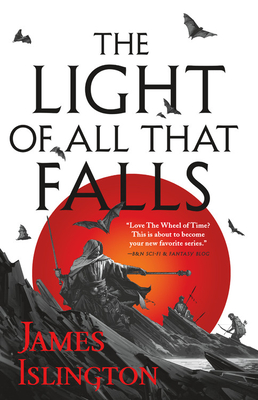
Wow. I just put down The Light of All That Falls, the final tome in the Licanius Trilogy, and this journey ended on such a touching note that I really wish there was even more. The only reason this book does not get the full five stars is that I did not have that feeling for much of the first half of the novel. To the contrary, even with the higher page count, this was the slowest reading experience I had across all three books.
The first half of The Light of All That Falls has a lot more in common with its immediate predecessor than with the first book in the series. This means that the main characters spend a lot of time split up (Asha and Davian actually spend the majority of this book in alternate dimensions/timelines) and the non-linear narrative makes it more challenging to keep track of all the moving pieces. This isn’t a knock against Islington by any means, it just isn’t my personal preference. That said, the new dimension of Zvaelar was an excellent addition, and much like Deilannis, shows Islington’s ability to create very creepy and dangerous locations within his fantasy universe. I just wish the scavenging storyline had been condensed, as it felt a bit like filler to give Davian something to do for a little while.
Once Davian returns from Zvaelar and Asha leaves the Tributary, this book becomes truly excellent. By the time our four main characters reunite, the remaining narrative has a clear sense of direction, and the choices that lie ahead for each member of the team are thematically rich. By the end of this experience, it is very clear why Islington decided to name the entire trilogy after Licanius, the sword of Fate. While some of the side plots and characters get sidelined, the core narrative really finishes strong and the final few chapters and the epilogue are really moving in ways that surprised me given the general lack of sentimentality in Islington’s writing.
Reflecting on the series overall, I would give this a strong recommendation, despite its imperfections. The growing pains and learning curve of a first time author are very much on display across all three books, but if you can look past that and appreciate the ambition of Islington’s concept, the ways he riffs on fantasy tropes, the abundance of exciting plot twists, and the thematic musings on fate, destiny, religion, morality, forgiveness, and the capacity of human beings to change, then you will really have a great time. For the most part, I did not struggle to get through at least 50 pages of any of these three books in a single sitting, and while some of the names and concepts can get a bit fuzzy in books two and three, Islington makes sure you don’t get lost for long.
I look forward to checking out Islington’s next project and really hope he keeps his promise to return to this world and fill in some of the gaps and side narratives.
The Light of All That Falls, James Islington
 The Once and Future Lit