Spoiler warning.
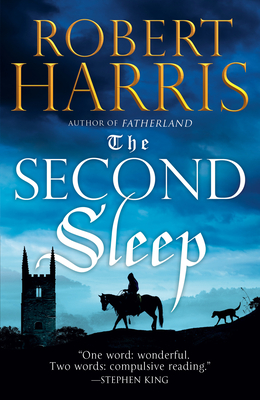
Robert Harris first came on my radar last year when I picked up his novel, Conclave, before the release of its film adaptation. While I enjoyed and appreciated the novel immensely, I found the ending to be incredibly polarizing, silly, and abrupt to such an extent that it really brought down my overall impression of the novel. So I wanted to pick up another Robert Harris mystery in the hopes that Robert and I would leave things on a more positive note the second time around. I can definitively say The Second Sleep was not that book. If reading Conclave felt like having a delicious meal where the final mouthful tasted like spoiled milk, reading The Second Sleep is akin to ordering a burger and having the waiter put chicken tikka masala in front of you instead. It may have still tasted pretty good, but it was definitely what I thought I was getting.
At first glance, The Second Sleep seems to be a mystery about a young priest who travels on his bishop’s orders to a small medieval English village to preside over the burial of the recently-deceased village priest. As the protagonist spends time in the village interacting with the locals and perusing the deceased’s belongings, he discovers that the circumstances of the elder priest’s death may not be what they seem. What I did not bargain for, was that The Second Sleep is a post-apocalyptic dystopian novel set 800 years after the fall of human civilization in the year 2025. In the centuries since, society has reverted to a medieval state in which organized religion (whose stone churches survived the Fall) once again becomes the political and cultural center of civilization, and the arbiters of truth and information. As he comes to realize this, our protagonist priest, Christopher Fairfax rediscovers Apple products, car windshields, laboratory beakers, and electricity and experiences a deep crisis of faith in the process. Harris’s exploration of how religions have historically held, manipulated, and suppressed knowledge, ideas, and science is excellent, as is his pontificating on how our fragile modern society may be on the cusp of destroying itself through any man-made number of triggers (climate change, nuclear war, computers, social isolation). Passages like this were particularly resonant:
“And we also know that almost every person, including children, was issued with a device that enabled them to see and hear one another, however far apart in the world they might be; that these devices were small enough to be carried in the palm of one’s hand; that they gave instant access to all the knowledge and music and opinions and writings in the world; and that in due course they displaced human memory and reasoning and even normal social intercourse – an enfeebling and narcotic power that some say drove their possessors mad, to the extent that their introduction marked the beginning of the end of advanced civilisation.”
The actual plot and characters in The Second Sleep are nothing special. Like Conclave, it was easy to rip through this novel in just a few days, but that was more out of a desire to see how the mystery would play out rather than out of any particular attachment or concern for the characters.
Having now given both of the Robert Harris novels I have read lukewarm reviews, I should feel no particular desire to read another, but for some reason, I’m still curious to explore his work. While his work always seems to end up veering away from my particular expectations and taste, I still have a ton of respect for Harris’s writing, the complex ideas and themes he weaves into his mysteries, and his nuanced approach to questions of history, philosophy, and faith. Maybe the third time will be the charm.
 The Once and Future Lit