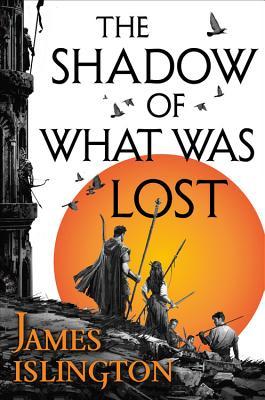
The Shadow of What Was Lost is the sweeping fantasy novel that I had been missing for years. I absolutely adored this book, and I am so impressed that this was the work of a first-time author who initially self-published this work. I am not at all surprised that this book eventually got picked up by a traditional publishing house, and that James Islington has continued to have major success in the fantasy genre over the years.
Islington is one of those writers who focuses heavily on plot, and he does it so well. This 700 page book is crammed full of plot twists, shifting alliances, quests, locations, and characters. As a result, the pacing is relentless, and I had a very hard time putting it down. Everything is communicated very clearly and directly, and a lot of the fantasy elements and world building are familiar enough (at least at first) that the barrier to entry is pretty low. If you are a fan of Harry Potter, The Lord of the Rings, A Song of Ice and Fire, and the Wheel of Time (though I cannot vouch for the latter two works having never read them myself) you will definitely feel at home in Islington’s world. One of the main characters starts out as a student at a magic school and he has a scar on his face. There are creepy supernatural agents of evil clad in black. There is a desolate land, separated from the rest of the world by an ancient but decaying barrier. All that being said, The Shadow of What Was Lost never felt derivative. While the set-up may be familiar, the twists and turns are so drastic that readers are never in familiar territory for too long.
While the characters are not given much time for internal reflection or emotional growth, I still really enjoyed them. And there are a lot of them. Each of the main point-of-view characters is a riff on a genre archetype (the hero, the best friend, the prince, the rogue, etc.) but Islington does a great job in this first novel tracking how each of them grows into their own individual power and purpose within this world. Islington also ensures that each of them also has a major reveal at some point, though some (Caeden) are much more shocking than others (Wirr).
Another wonderful feature of Islington’s writing is how easily he brings this world and the fantastical beings within it to life. Locations like the haunted city of Deillanis are so clearly painted; threats like the Sha’teth and Orkoth are both terrifying and cool; and the way that magical powers and objects such as Davian’s lie detector ability and the portal box are described make this an incredibly cinematic reading experience. Similarly, Islington’s world-building is great. While the geography takes getting used to (and the map isn’t always helpful), the mythology behind this world is great. This is especially true when Islington uses memories and storytelling to share fables and history. Davian’s journey into Malshash’s memory and the story he reads from the Collection of Darecian Fables are incredibly strong stand-alone short stories and the latter, in particular, reminded me of the Tale of the Three Brothers from Harry Potter and the Deathly Hallows.
If there is one thing that holds this book back, it is that Islington’s prose can be a bit too simple and repetitive at times. There are definitely points where my editorial instincts made me want to cross out redundant words and phrases, here and there.
This book will not redefine the genre or stand up as a great literary work of fiction in the way Tolkien has, but that does not mean it isn’t fantastic. If you’re looking for a fun, fast-paced, fantasy epic to bury your head in, I cannot recommend this highly enough, and I cannot wait for what the next two installments have in store… especially after that ending.
 The Once and Future Lit