
“Kindly consider the question: what would your good do if evil did not exist, and what would the earth look like if shadows disappeared from it? Shadows are cast by objects and people. Here is the shadow of my sword. Trees and living beings also have shadows. Do you want to skin the whole earth, tearing all the trees and living things off it, because of your fantasy of enjoying bare light? You’re stupid.”
What a thesis statement for this remarkable work! Mikhail Bulgakov’s The Master and Margarita is one of the strangest, funniest, most twisted, and most subversive works I have ever read. I imagine this is the kind of novel that can be read time and time again and be interpreted differently each time, even by the same reader.
From one lens, this is a novel about the devil and his entourage of goons running wild, wreaking havoc on the citizens of Moscow like children let loose in a toy store. From the very opening chapters, the devil (Woland) gives readers a taste of his talents and tastes: precognition, dark comedy, deception, banter, violence, and gore. Throughout the novel readers are treated (or subjected) to beheadings, lunacy, reanimation of the dead, arson, witchcraft, seances, anthropomorphism, arson, nudity, vampirism, and all manner of hooliganism, orchestrated by Satan himself. And it’s all wildly weird, amusing, and hilarious. Behemoth, the large black cat who walks on two legs, drinks vodka, plays chess, shoots guns, and swings from chandeliers made me laugh out loud several times.
On a deeper level, however, Bulgakov’s most famous novel is a biting satire and critique of the culture of censorship, surveillance, and totalitarian control the Stalinist Soviet Union. After all, is it any less terrifying for neighbors to disappear at the hands of the state apparatus than it is if they are taken by the devil himself? While the rotating cast of characters all address this theme in one way or another, Bulgakov’s titular “master” best illustrates how censorship and the stifling of free thought and the arts can crush the human soul. Even before the denizens of hell show up in Moscow, the master has already been broken by the oppressive orthodoxy of the Stalinist culture and institutions that stand between him and his dream of publishing his life’s work – a novel about Pontius Pilate and the crucifiction of Jesus of Nazareth (Yeshua Ha-Nozri) in the ancient city of Jerusalem (Yershalaim). The religious subject matter (while significantly deviating from Christian Gospel orthodoxy itself), is an absolute non-starter for Soviet publishers, leaving the master completely rejected and despondent. This rejection of his art proves to eat away at him so much that he ends up setting fire to his manuscript and disappearing, locked away in a mental institution. Like other disappearances throughout the novel (and in Stalinist society), the effects impact not only the disappeared, but also their loved ones. This ripple effect is best shown through Margarita, the master’s lover who is completely unsettled and depressed by his sudden unexplained disappearance – so much so that she is willing to make a literal deal with the devil to find her lost love and read the ending of his novel. Funnily enough, it ends up being the devil who gives Margarita hope, instructing her that the ending of the master’s novel will never be truly lost because, despite the wishes of the author, the state, or any other censor, “manuscripts don’t burn,” because ideas cannot be destroyed.
As the novel unfolds, Bulgakov just keeps pouring ingredients into this bubbling cauldron of political commentary, satire, surrealism, philosophy, occultism, and black comedy. This is the kind of novel that is probably not for everyone, and there are so many cultural references and jokes embedded in this text that I doubt any contemporary reader (especially reading this work in translation from the original Russian) will ever find or understand them all. While a pre-existing knowledge or Russian culture, literature, and history, Christian gospels, and Stalinist politics will certainly enrich this reading experience, I do not think it should intimidate readers out of giving this book a try. Read the first few chapters, and by the time the tram car comes to a stop in chapter three, you will have a good sense of if you will enjoy this or not. I certainly did!
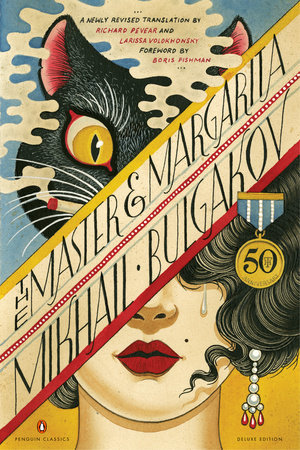
The Master and Margarita, Mikhail Bulgakov
 The Once and Future Lit