
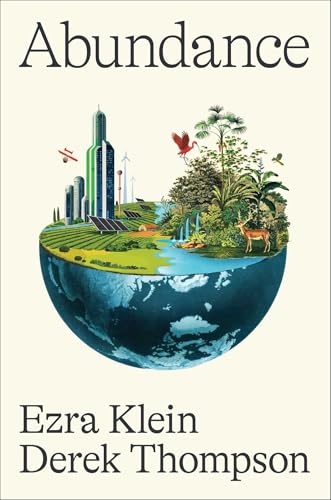
Abundance should be essential reading for anyone concerned with the future of liberal governance in the United States.
There are many reasons the Democratic Party went down in flames in 2024, and that Donald Trump returned to power more popular and powerful than ever before, but the failure of liberal policies and programs to deliver was a sizeable part of that equation.
In this book, which was already being drafted by the time Trump won re-election, Ezra Klein and Derek Thompson do an excellent job diagnosing and analyzing the ways in which liberal government continues to shoot itself in the foot, time after time. Whether it be the doomed, embarrassingly over-budget and down-scaled project of California high-speed rail, the affordable housing and homelessness crises in Democrat-run states and cities, or the calcified nightmare of the federal rulemaking and grantmaking processes, Klein and Thompson make it very clear that American liberals desperately need a come-to-Jesus moment.
To quote the authors, “Liberals should be able to say: vote for us, and we will govern the country the way we govern California! Instead, conservatives are able to say: Vote for them, and they will govern the country the way they govern California!” A significant portion of this book hones in on California as ground zero for the issues that Klein and Thompson identify as critical problems of liberal governance: lawn-sign liberalism, and litigiousness and burdensome regulations driving projects into the ground. But the criticism of liberal policy implementation at the federal level is also well-researched and explained. Given my background in federal administrative law, experience shepherding rules and notices through the process, and experience scoring applications for federal grant money, I wanted to applaud the authors for their excoriation of the Biden administration’s implementation of its Notice of Funding Opportunity (NOFO) for $39 billion it intended for semiconductor manufacturers to locate new facilities in the United States. In explaining what they refer to as the problem with “everything-bagel liberalism,” Klein and Thompson illustrate how the stubborn insistence on throwing countless social pet issues into projects and programs that should be entirely focused delivering their stated objective ultimately leads to bloated budgets, fewer opportunities for smaller bidders, slow delivery, and even outright failure.
While I found the first few chapters of Abundance utterly compelling, I was less engaged by the final two chapters, which I found reiterated many of the same principles already covered, but with a focus on federal grants, scientific innovation, and strategies for spurring technological inventions that can solve problems such as climate change and diseases.
In the conclusion, the authors state, “to pursue abundance is to pursue institutional renewal,” and they caution liberals to move beyond the impulse to merely defend what their opponents attack. In the aftermath of Donald Trump’s return to office, there are many reasons for Democrats, liberals, and other institutionalists to instinctively defend government and its many legacy rules, norms, and systems. This is a mistake. Instead, this is an opportunity for those sympathetic to liberal governance to advocate for meaningful changes, regulatory reforms, and an abundance agenda in which “we solve our problems with supply.” I really believe this book is a timely cornerstone upon which to begin that project, and I take heart that it seems to be getting a lot of attention in Washington, DC upon release.
 The Once and Future Lit