
Spoiler warning.
“We like to believe, or pretend, we know what we are doing in our lives. It can be a lie. Winds blow, waves carry us, rain drenches a man caught in the open at night, lightning shatters the sky and sometimes his heart, thunder crashes into him bringing the awareness he will die. We stand up as best we can under that. We move forward as best we can, hoping for light, kindness, mercy, for ourselves and those we love. Sometimes these things come, sometimes they do not.”
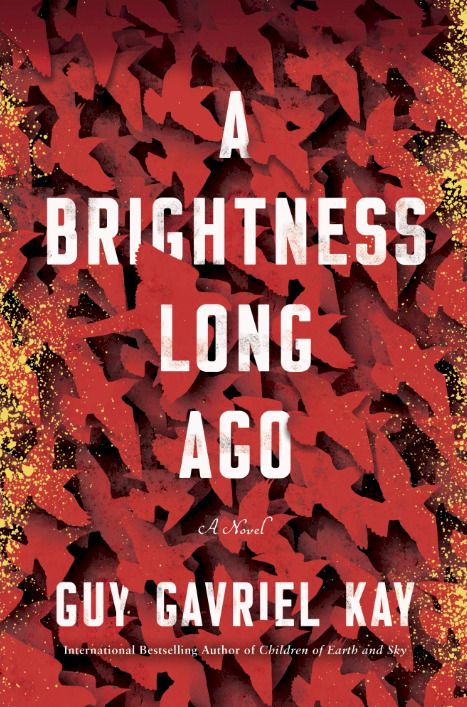
Guy Gavriel Kay’s work has been on my radar for some time, and I had incredibly high expectations for A Brightness Long Ago, both as a standalone and as an entry point into Kay’s body of work. I am so happy to say that I really loved this book, despite it not being quite what I expected.
While I was aware that Kay’s works largely take place in alternative versions of real historical places and events, I was surprised by just how subtle the fantasy elements are in his work. If you want high fantasy, mythical creatures, and complex magic systems, Kay is not your guy. Instead, his version of fantasy offers just a taste of the mystical with glimpses of the afterlife. And it works so well.
Plot also takes a bit of a backseat in A Brightness Long Ago. Sure, events happen, but they play out more like a serious of memories that serve the narrator’s exploration of how the person we become is shaped by the events, choices, external forces, and people who touch our lives – even briefly. This novel is not an epic narrative tale. It is a reflective work focused on themes and characters. While characters in this book experience love, joy, and victory at times, this is a story full of grief, loss, and disappointment, and Kay seems far more interested in how his characters deal with those emotions. The narrator, Danio, is particularly devastated by the loss of Adria, who, despite their paths only crossing briefly, leaves a deep mark on his soul. When he learns of Adria’s assassination and the feels the tragedy of a great life cut short, Danio delivers one of the most beautiful reflections on loss: “The sailors say the rain misses the cloud even as it falls through light or dark into the sea. I miss her like that as I fall through my life, through time, the chaos of our time. I dream she is alive even now, but there is nothing to give weight or value to that, it is only me, and what I want to be true. It is only longing. We can want things so much sometimes. It is the way we are.” This is the kind of wonderful, reflective prose Kay scatters throughout this book, bringing out the most important and emotionally impactful moments, and inviting us readers to reflect on how fate and fortune touch our lives.
While Danio’s story largely centers on the power of love, the lifelong rivalry between Folco Cino d’Acorsi and Teoboldo Monticola di Remigio explores the petty and destructive power of hatred. Across decades, two relatively minor mercenary lords obsessively clash with one another over their ultimately-inconsequential grievances. For much of the book, I kept expecting to learn there was some great underlying reason for this blood feud between the two men. But toward the end of the novel, I realized that the feud was never meant to be justified. Instead, while the two men stand ready to kill one another in battle, they learn of the fall of Sarantium, the City of Cities. This event is such a rupture in the world that every character is deeply shaken by it. Kay makes it very clear that squabbling lords who obsess over their own comfort, status, grievances, and profit over protecting that which is sacred are as culpable for its destruction as the conquerors themselves. This is a timeless theme that can be applied to any number of issues, even in the modern world. I am curious to read how Kay explores the fallout of the fall of Sarantium in other books. Here, the characters are left largely feeling afraid and unmoored. While individual characters in the story seem inspired to change for the better having seen the consequences of their short-sightnedness, it is also heavily suggested that this contrition may not last. At the end of the day, the world is still the world, and people are still people.
A Brightness Long Ago is a very reflective work, but Kay also knows how to deliver a good time. This book has no shortage of violence and sex, and there are some truly exciting action scenes. The horse race in Bischio is one of the best-written and well-staged action scenes I have ever read, and the Monticola’s death was genuinely shocking. The way Kay writes recently-deceased characters drifting away into the afterlife is great, and there is a decent presence of witchcraft and ghosts, featured mostly in the chapters written from Jelena’s point of view. While the majority of the story is told from the perspective of Danio, Adria, and Jelena, there are many vignettes that offer different characters’ perspectives, often on the same events. Kay has an incredible talent for making you fall in love with minor characters whose perspectives are given for a handful of pages before they are dismissed from the narrative entirely.
If I have one criticism of this book, it would be that it took me a few chapters to really wrap my head around the cast of characters and the geography of the world. The list of characters and the map at the front of the book were helpful, but I eventually stopped using them and just trusted that Kay would tell me what I needed to know at the appropriate moment. That mostly proved true.
The more I write, the more I want to say about this relatively short novel. The historical parallels to the Italian Renaissance city states and the fall of Constantinople. The commentary on the roles women played in Renaissance Italy. The politics. The religion. The characters whose names and sub-plots I have not even mentioned. I know this is a book that will definitely benefit from a re-read at some point, but first, I cannot wait to gradually make my way through Kay’s other works. If A Brightness Long Ago is anything to go by, I can easily see Guy Gavriel Kay quickly becoming one of my favorite authors.
“Perhaps it is true of every life, that times from our youth remain with us, even when the people are gone, even if many, many events have played out between where we are and what we are remembering. I am so full of memories tonight from that time – when I was being changed, made and remade by those I met.”
 The Once and Future Lit