
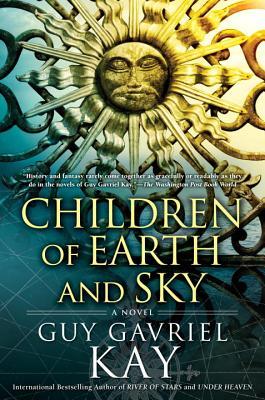
Children of Earth and Sky was my second Guy Gavriel Kay adventure, and seemed an appropriate follow-up to A Brightness Long Ago. While each of these two novels is a stand-alone, they are both set in the same fictionalized version of Renaissance-era Italy and the Eastern Mediterranean. Set roughly 25 years after the events of A Brightness Long Ago, Children of Earth and Sky grapples with the fallout from the conquest of Sarantium by the Asharites, spotlights the court politics of Seressa (this world’s Venice), and explores the skirmishes and instability of the borderlands that lie between the main Jaddite powers in the West, and Asharite empire in the East.
Despite the shared universe, Children of Earth and Sky is very different from A Brightness Long Ago. This novel has a much more linear narrative structure and feels a lot more grounded, whereas A Brightness Long Ago felt a lot more reflective and thematic. In many ways, Children of Earth and Sky reminded me of Ken Follett’s Kingsbridge novels (particularly Pillars of the Earth and The Evening and the Morning), albeit with much more lyrical prose. In this novel, we follow a cast of characters of various nationalities, religions, and walks of life as they struggle to navigate a harsh and often violent world. While there are many, many point-of-view characters, the narrative largely centers around Danica Gradek (a young woman mercenary who, accompanied by her dog, uses her skills with a bow and knives to exact vengeance on Asharites for destroying her family and her home), Pero Villani (a young Seressini artist commissioned to travel to Asharias to paint the Sultan’s portrait), Leonora Valeri (a spy desperate to distance herself from her father and a tragic loss), and Damaz (a boy taken from his Jaddite family at a young age, stripped of his identity, and raised to fight and kill for the opposing Asharite army). Each character’s arc is incredible, but I do think Kay could have done more with each of them, as well as many others. While this is not a short book, its roughly 570 pages just did not feel like enough, especially toward the end. For example, I absolutely loved everything about Pero’s time in Asharias, but it was over after little more than a chapter, after over 400 pages of anticipation and build-up.
Beyond the characters and the narrative arcs, I also really have to admire the world-building Kay managed here. Even more than A Brightness Long Ago, this novel really fills out the world these characters inhabit. There is a lot more exploration of the different world religions, the city state politics, diplomacy, espionage, and art. Everything that happens at the Jaddite retreat in Dubrava sums this up very well, and the presence of the exiled empress Eudoxia of Sarantium was a real treat.
Overall, I loved this book and I am well on my way to being a Guy Gavriel Kay mega-fan. It’s not as tightly plotted as A Brightness Long Ago, and there were far fewer beautiful passages and quotes that stood out to me, but Children of Earth and Sky is a fantastic read for fantasy and historical fiction fans, and readers who prefer a bit more action may actually prefer this to A Brightness Long Ago.
 The Once and Future Lit