
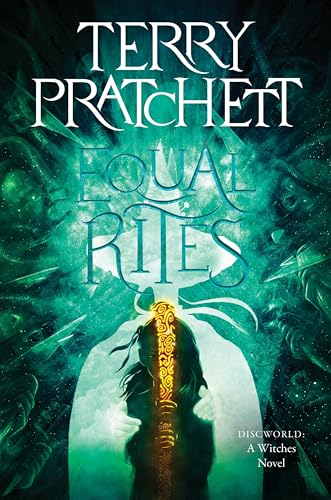
When I decided I would read the Discworld novels in release order, I was very aware that many fans (including the author himself) caution against this because Terry Pratchett took a few books to hit his stride and really master the tone of Discworld. I made my way through The Color of Magic and The Light Fantastic with this in mind, and my preconception of Equal Rites was that fans generally view it as an improvement on the previous two books while still thinking it is not yet Pratchett at his best. Many fans even argue that Equal Rites does not even serve as the best entry into the Witches sub-series because of its characters and subject matter do not reflect the remaining five books very well. While this is all true and I believe my preconception of Equal Rites was largely correct, I still enjoyed this book for what it was. It’s very close to being a four-star book, but not quite.
Unlike the first two Discworld novels, I was able to rip through Equal Rites in about a day. It is very readable and there is a lot less chaotic energy on the page, while still being full of Pratchett’s signature wit and whimsy. Having followed the adventures of Rincewind the wizard for two books, Equal Rites introduces readers to Discworld’s witches. Unlike wizards, whose magic comes from the sky and is centered on stars and numbers and other “jommetry,” witches drawn their magic from the ground through herbs, plants, animals, and what Granny Weatherwax would call “headology.” This dichotomy is a lot of fun, but Equal Rites immediately calls it all into question by asking: can a woman be a wizard? Enter Eskarina Smith, a young girl who accidentally inherits the staff of a dying wizard (an inheritance traditionally reserved only for the eighth son of an eighth son). Under the mentorship of Granny Weatherwax (the most witchy of witches), Eskarina learns “headology” to become a witch and travels to the Unseen University hoping to be accepted by the wizards. Along the way, Pratchett introduces readers to a stacked cast of characters and charming locales that add to Discworld lore. While the feminist theme may feel a bit trite to a reader today, it remains entirely good-spirited and doesn’t hit you over the head with ideology. Far more than in the previous two books, Equal Rites demonstrates why Pratchett and his Discworld are so beloved for their rich social commentary packaged in a whimsical, genuinely funny fantasy world.
Throughout this book, Pratchett finds comical ways to question assumptions, pushing both the characters and the reader to reflect on why they believe what they believe and do the things they do. Why are all wizards men? Why are all witches women? If a witch doesn’t wear her pointy hat, how will people know she’s a witch? You get the idea.
Three books in, it finally feels like the Discworld is really about to go from a good time to a great time. Even in these early books, these stories are enjoyable breaks from heavier, longer reads. If Discworld isn’t cozy fantasy, I don’t know what is.
 The Once and Future Lit