
Journey before Destination.
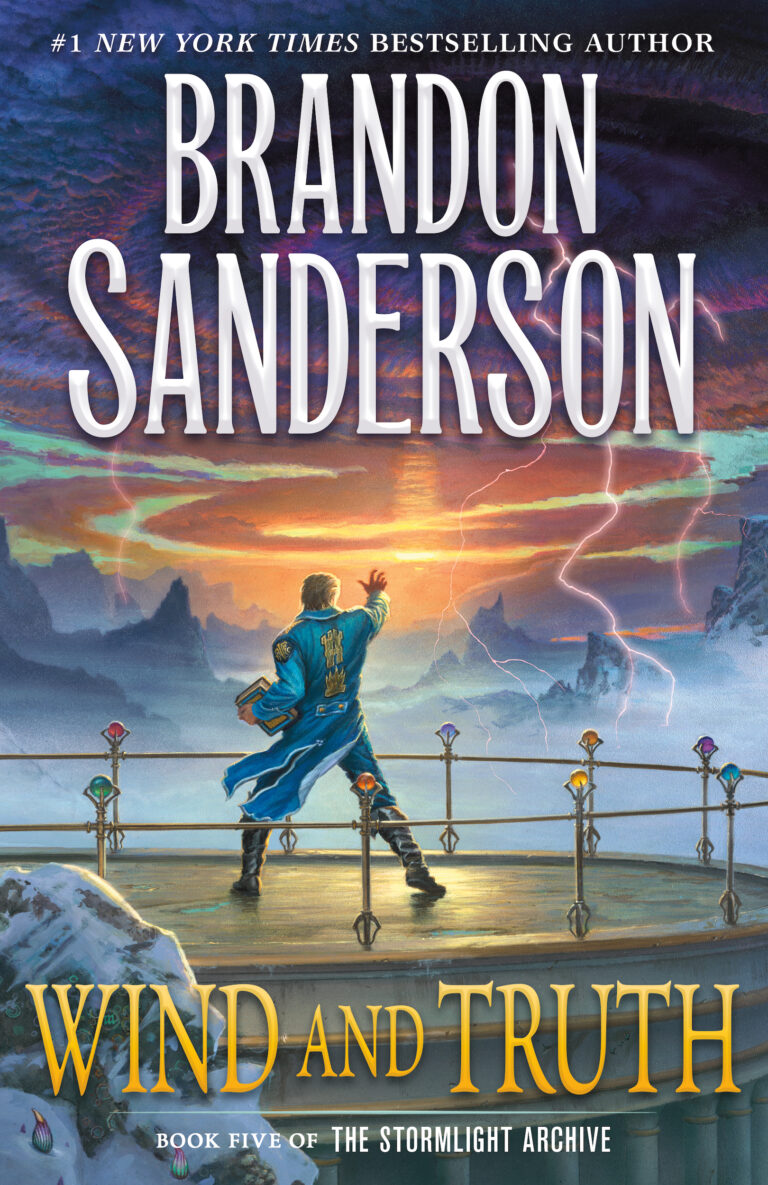
Well, after reading all 5,919 pages of the first arc of The Stormlight Archive this year, including the 1,344 pages that make up the behemoth Wind and Truth, I have at last reached the destination. There is so much to say about this book that I think it best to divide this review into a brief spoiler-free section followed by a full spoiler review of each point-of-view character’s arc in order of enjoyment.
Spoiler-Free Thoughts:
Wow! I was a bit cautious going into Wind and Truth. I had seen and heard chatter that this was somehow the worst Stormlight book: disappointed fans claiming Sanderson had somehow betrayed them; that the book felt unfinished, bloated, and badly paced; that the promised “ending” was no ending at all; that Sanderson’s writing and humor were unusually unimpressive; that Sanderson had gone “woke.” So consider me beyond relieved as I opened Wind and Truth and was immediately engrossed. From the prologue until the postlude this book had me enthralled.
Are there flaws? Yes. A committed editor could have easily cut 200 pages and the book would have been no worse off. There is some unfunny humor and cringeworthy dialogue. But those revisions are no more needed here than in any other Stormlight book, and in no way did they undermine the majesty of the story, lore, and character journeys on display. More than any other Stormlight book, Wind and Truth finally unleashed deep lore and worldbuilding about the most mysterious forces on Roshar and throughout the Cosmere. If you enjoy learning the history and cosmology of fantasy worlds, this book should delight you.
As far as pacing goes, I actually found this to be the best-paced Stormlight book. In Wind and Truth, Sanderson strays from the five-part formula of books one through four and instead divides this book into ten parts, each chronicling a single day in the lead-up to the climactic showdown with Odium. This new structure made it a lot easier to organize my reading, and I ended up finishing the book in a little more than ten days myself.
All of my favorite characters got their due, and then some, in this book. Without getting into spoilers, I would rank the character arcs in Wind and Truth as follows: Szeth, Dalinar, Kaladin, Odium, Adolin, Gavilar, Honor, the Heralds, Shallan, Wit, Jasnah, Renarin, Rlain, Navani, Cultivation, Sigzil, Venli, Moash, Lift.
Overall, I am very satisfied with the ending to the first arc of The Stormlight Archive, and I cannot believe I now have to wait so many years (probably a couple decades) for the ultimate ending at the end of the second arc. Luckily, there are many other Cosmere books out there to tide me over. Oathbringer is still my favorite book in the series, but it’s a lot closer than I ever expected.
Ranking the First Arc of The Stormlight Archive:
- Oathbringer (Book 3, 9.8/10)
- Wind and Truth (Book 5, 9.5/10)
- Words of Radiance (Book 2, 9.2/10)
- The Way of Kings (Book 1, 9.0/10)
- Rhythm of War (Book 4, 8.8/10)

Spoiler Thoughts, by Character:
Szeth:
Ever since the prologue of The Way of Kings, Szeth has been one of the coolest characters in this series. In this book, the Assassin in White finally gets his due. His flashback chapters are second only to Dalinar’s in Oathbringer, and they give the reader so much insight into Shinovar. The Honorbearer monasteries were incredibly cool checkpoints—physical challenges that also served to punctuate Szeth’s journey toward emotional healing and breaking out of his conditioning. The illusion puzzle in the Lightweaver monastery was especially creative. Through Szeth, Sanderson did such a good job exploring the toll war and conscription take on an innocent child who only ever wanted to live in peace and raise his sheep in the beautiful Shin countryside. Everything to do with Mollie the sheep broke my heart, and when Szeth rediscovered the little trinket made from her fur exactly where he had left it as a child, I teared up.
Dalinar:
Dalinar Kholin remains my favorite character across the entire five-book arc, and much like in Oathbringer, I personally enjoy him most when he is learning and reflecting by journeying across time through visions. Most of Dalinar’s journey in Wind and Truth takes place alongside Navani and Gavinor in the Spiritual Realm, seeing the history of Roshar play out before his eyes. Through this Dalinar comes to understand Honor—the concept and the Shard—and I loved every word. The payoff, Dalinar’s sacrifice atop Urithiru, feels completely earned, and his realization that the final lesson he needed to learn was when to give up power and put his faith in others was a perfect ending. I am a little uncomfortable with the idea that Odium may be able to bring Dalinar back via an alternate-dimension version of the Blackthorn, but I choose to trust Sanderson.
Kaladin:
Let’s get this out of the way: Kaladin has the single worst line of dialogue in this entire novel (“I’m his therapist.”) But he also has many of the absolute best moments, especially his final decision to sacrifice himself and take up the mantle of a Herald so that Szeth can finally be free to lay down his arms and live. Shifting Kaladin from the role of warrior to supportive companion was a risky move, but it worked. I smiled when Kaladin spoke the Fifth Ideal, when he repeated the iconic “Honor is dead, but I’ll see what I can do” line from Words of Radiance, when he played the flute, and when he looked back on all the different iterations of himself we’ve followed through this incredible journey of growth.
Odium:
The absolute best part of Rhythm of War was Taravangian’s ascent to Odium, and the new vessel for the Shard did not disappoint here. My jaw dropped when he wiped Kharbranth off the map. I wanted to strangle him when he turned Fen against Jasnah. And he served as the perfect foil to Dalinar and all of Roshar across every realm. Whereas Rayse’s Odium felt like a more traditional and aggressive dark lord, Taravangian is the kind of villain propelled toward victory because he desires to achieve some version of good, even if his methods are deeply cynical and cold. Did Odium win at the end of this book? I think we’re supposed to say yes, but as revealed in Wit’s reflections and Odium’s own thoughts, even he can’t be satisfied because he knows that Dalinar still managed the moral victory.
Adolin:
For the first half of Wind and Truth, I worried that Adolin, Jasnah, and Sigzil would all have duplicate roles, each overseeing a different battlefield. If this had been the entirety of Adolin’s arc, I would have been disappointed, but his journey really took a turn for the better. For much of the book, I had this gut feeling that Adolin was marked for death, and once he battled the thunderclast and lost his leg, I realized that Sanderson had done something so much more interesting. He turned the perfect soldier—the pretty boy, the son who had always lived up to his father’s expectations and the brother who had always defended vulnerable Renarin—and knocked him down. He made him vulnerable and physically weak only to build him back up again. Adolin was such a wonderful friend and mentor to Yanagawn, and his journey to forgiving his father and healing their relationship was beautiful.
Gavilar:
There isn’t too much to say about a character who died in the prologue of the very first book of this series. But seeing the events of that night play out from his perspective in the prologue of this book was great.
Honor:
Honor serves an interesting role in Wind and Truth. As the power itself, as Tanavast, and as the Stormfather, Honor is much of the focus of Dalinar and Navani’s journey through the Spiritual Realm. The god is also the vessel through which we learn a lot about the history of Roshar and the relationships the gods have to one another. The chapters told from Honor’s perspective throughout day nine are a gold mine of lore.
The Heralds:
Like Honor and Odium, the Heralds finally get their due in Wind and Truth. All of them? No. There are still quite a few among the ten whose names I can’t place to faces in the beautiful inside-cover illustrations in these books, but a few of them and the overall role the Heralds play in the history of Roshar and the Desolations are really interesting.
Shallan:
I liked Shallan a lot more than most people seem to in the first three books, but in this book, as in Wind and Truth, she seemed to fade into the background and play a less central role in the overall plot. She is mostly along for the journey through the Spiritual Realm with Renarin and Rlain, hunting the Ghostbloods and searching for Ba-Ado-Mishram’s prison. I would have much rather Shallan got to spend more time with Adolin or Jasnah in this book, as her relationships with those two feel unresolved in different ways. That said, the revelation that Shallan’s mother is a Herald and that Shallan killing her played a major role in kickstarting the events of this series was a great twist.
Wit:
Wit is the perfect embodiment of the ethereal, wise character who also has a great sense of humor. This is exemplified in the early scene where he sets Kaladin on his quest and gifts him the flute while wasting Dalinar’s time. I also found Wit’s letter to Jasnah (Day 7 epigraphs) really touching.
Jasnah:
As I said in discussing Adolin, Jasnah felt like she was in a bit of a holding pattern for a bit, but her debate with Odium to win Fen’s continued allegiance was a wonderful piece of character exploration.
Renarin and Rlain:
While both of these characters (and their budding relationship) get more attention in Wind and Truth than in prior entries, I wanted more out of both arcs. Since The Way of Kings, both characters have been established as outsiders. Renarin in particular was very mysterious, and I expected this would lead to him having some especially rare powers. Rlain’s loneliness as the only singer among humans in Bridge Four was very sympathetic, especially in Rhythm of War. I like what Sanderson went for here in embodying human-singer unity in this relationship, but I think it would have worked better with characters who had a more central relationship to the main story. If he returns for the second arc of the series, I’m hoping for big things from Renarin, and I really want to see how his relationship with his brother evolves going forward.
Navani:
Navani was basically the main character of Rhythm of War, but she takes a step back in Wind and Truth. She spends most of the book sharing visions with Dalinar. Nothing particularly stood out here.
Cultivation:
I wanted more. I would have loved to have seen Cultivation in dragon form, to see her interact with Dalinar and Lift. Also, what happened to the Nightwatcher?
Sigzil:
In each book, it seems Sanderson picks a couple of members of Bridge Four to take on the spotlight, and this time it was Sigzil’s turn. Someone had to take on the role of Windrunner general since Kaladin was off in Shinovar with Szeth, but Sigzil just isn’t as interesting as Rock, Lopen, Teft, or Rlain. The absence of Rock and Dabbid in this book was unfortunate.
Venli:
Venli and the Listeners play a relatively small role in Wind and Truth. They discover the well below the Shattered Plains and help secure the plains so that Urithiru continues to function going forward. After all the attention given to Venli (and Eshonai) earlier in the series, especially in Rhythm of War, wouldn’t one of them have been a better symbol of human-singer cooperation than Rlain?
Moash:
It’s telling how much the power has scaled and the stakes have risen in this book that Moash is at best a minor antagonist this time around, relegated to being a thorn in Sigzil’s side.
Lift:
I really don’t like Lift as a character. Her Edgedancer powers are interesting, but it’s time for her to grow up. A good portion of Sanderson’s bad humor and characterization centers on this character. I understand that she’s supposed to be annoying and immature, but I don’t want her in my epic fantasy book.
 The Once and Future Lit