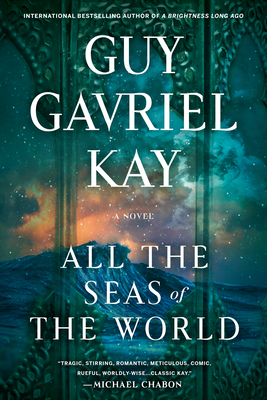
All the Seas of the World is the third (in publication order) novel in Guy Gavriel Kay’s loosely connected trilogy of books set in a historical fantasy world closely resembling Renaissance Europe. Alongside its predecessors, Children of Earth and Sky and A Brightness Long Ago, All the Seas of the World explores the lives of a diverse cast of characters navigating the political, religious, and military conflicts of Kay’s alternate Mediterranean world. Kay argues that each of these three novels is a complete stand-alone and can be read in any order. I would argue that reading All the Seas of the World first—especially before A Brightness Long Ago—would make this a far less enjoyable read. While not a direct sequel, there are several overlapping characters, major plot spoilers, and references that cannot be fully appreciated without having read A Brightness Long Ago.
All the Seas of the World also closely resembles A Brightness Long Ago in style and tone, even if its characters and plot are more reminiscent of the faster-paced Children of Earth and Sky. While it never quite reaches the incredible highs of A Brightness Long Ago, Kay’s writing in All the Seas of the World is absolutely beautiful, and I bookmarked several pages so I can easily re-read the lovely reflections on life contained within these pages.
As excellent as this book is, it was easily my least favorite of the three books in this grouping. Maybe the fact that I started reading this book while traveling is partially to blame, but it took me a while to fully connect with the plot and characters. After the opening assassination in the early chapters of the book, I felt somewhat adrift for a while and had a hard time remembering all the characters and their motives. However, somewhere around the halfway point, things finally clicked, and I tore through the back half of the novel, thoroughly enjoying it.
Many Kay fans seem to regard All the Seas of the World as one of his lesser entries, and I can see why. It is not as exciting as Children of Earth and Sky and is not as refined as A Brightness Long Ago. And yet, my least favorite of these three books is still more beautifully written than most of the books I’ve read in both the fantasy and historical fiction genres. Three books in, Kay is already on my list of all-time favorite authors. Now that I’ve completed these more recent novels, I am very excited to read his most beloved works, including Tigana, The Lions of Al-Rassan, A Song for Arbonne, and The Sarantine Mosaic duology.
 The Once and Future Lit