
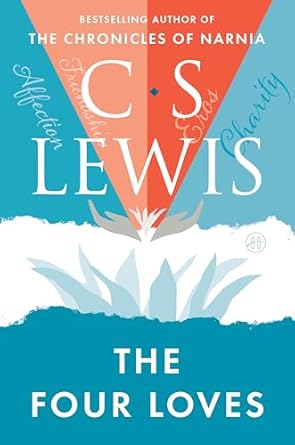
The Four Loves is a wonderful little book. I continue to be amazed at C.S. Lewis’s ability to fill so few pages with such rich material. As a result, The Four Loves—much like Mere Christianity—is the kind of book that benefits from focused, deep reading (and re-reading).
While some of Lewis’s cultural and literary references and tangents feel dated, or at times even indulgent, the core philosophy contained within this book speaks to timeless truths about human behavior and conflicts as we navigate relationships across all facets of life. Across every chapter, Lewis’s words about the nature of affection, friendship, romance, and charity struck a chord with me and caused me to reflect deeply on the state of my own relationships, as well as what I observe in my immediate circle and society at large. The deep humanity, sincerity, and rigor of Lewis’s writing was cathartic to read.
In each chapter there was at least one moment where I thought some version of, “I couldn’t have said it better myself,” “Those are the words I’ve been searching for,” “I wish [person X] would read this and take it seriously,” or, “I’m not insane to think [behavior or mentality Y] is right/wrong.”
The Four Loves is a powerful and contemplative work, and I hope to continue revisiting it and discussing it in the future. Again, I encourage potential readers not to be intimidated by Lewis’s abundance of reference that take the reader’s foreknowledge too-much for granted. Rather, read for the overall ideas and philosophies about how best to evaluate our relationships with ourselves, others, and the divine.
Quotes
Affection
“What we have is not “a right to expect” but a “reasonable expectation” of being loved by our intimates. If we, and they, are more or less ordinary people. But we may not be. We may be intolerable. If we are, “nature will work against us. For the very same conditions of intimacy which make Affection possible also – and no less naturally – make possible a peculiarly incurable distaste; a hatred as immemorial, constant, unemphatic, almost at times unconscious, as the corresponding form of love.”
“The most unlovable parent (or child) may be full of such ravenous love. But it works to their own misery and everyone else’s. The situation becomes suffocating. If people are already unlovable a continual demand on their part (as of right) to be loved – their manifest sense of injury, their reproaches, whether loud and clamorous or merely implicit in every look and gesture of resentful self-pity – produce in us a sense of guilt… They seal up the very fountain for which they are thirsty. If ever, at some favored moment, any germ of Affection for them stirs in us, their demand for more and still more, petrifies us again. And of course such people always desire the same proof of our love; we are to join their side, to hear and share their grievance against someone else… All the while they remain unaware of the real road. “If you would be loved, be lovable,” said Ovid… The really surprising thing is not that these insatiable demands made by the unlovable are sometimes made in vain, but that they are so often met.”
Friendship
“In a perfect Friendship this Appreciative love is, I think, often so great and so firmly based that each member of the circle feels, in his secret heart, humbled before the rest. Sometimes he wonders what he is doing there among his betters. He is lucky beyond desert to be in such company. Especially when the whole group is together; each bringing out all that is best, wisest, or funniest in all the others. Those are the golden sessions; when four or five of us after a hard day’s walk have come to our inn; when our slippers are on, our feet spread out toward the blaze and our drinks are at our elbows; when the whole world, and something beyond the world, opens itself to our minds as we talk; and no one has any claim on or any responsibility for another, but all are freemen and equals as if we had first met an hour ago, while at the same time an Affection mellowed by the years enfolds us. Life — natural life — has no better gift to give. Who could have deserved it?”
“I have no duty to be anyone’s Friend and no man in the world has a duty to be mine. No claims, no shadow of necessity. Friendship is unnecessary, like philosophy, like art, like the universe itself (for God did not need to create). It has no survival value; rather it is one of those things which give value to survival.”
“In friendship…we think we have chosen our peers. In reality a few years’ difference in the dates of our births, a few more miles between certain houses, the choice of one university instead of another…the accident of a topic being raised or not raised at a first meeting–any of these chances might have kept us apart. But, for a Christian, there are, strictly speaking no chances. A secret master of ceremonies has been at work. Christ, who said to the disciples, “Ye have not chosen me, but I have chosen you,” can truly say to every group of Christian friends, “Ye have not chosen one another but I have chosen you for one another.” The friendship is not a reward for our discriminating and good taste in finding one another out. It is the instrument by which God reveals to each of us the beauties of others.”
Eros
“The grim joke is that this Eros whose voice seems to speak from the eternal realm is not himself even permanent. He is notoriously the most mortal of our loves. The world rings with complaints of his fickleness. What is baffling is the combination of this fickleness with his protestations of permanency… No experience will cure him of the delusion. We have all heard people who are in love again every few years; each time sincerely convinced that “this time it’s the real thing”, that their wanderings are over, that they have found their true love and will themselves be true till death.”
“Can we be in… selfless liberation for a lifetime? Hardly for a week. Between the best possible lovers this high condition is intermittent. The old self soon turns out to be not so dead as he pretended… But these lapses will not destroy a marriage between two “decent and sensible” people. The couple whose marriage will certainly be endangered by them, and possibly ruined, are those who have idolized Eros. They thought he had the power and truthfulness of a god. They expected the mere feeling would do for them, and permanently, all that was necessary. When this expectation is disappointed they throw the blame on Eros or, more usually, on their partners.”
“When lovers say of some act that we might blame, “Love made us do it,” notice the tone…They “feel like martyrs”. In extreme cases what their words really express is a demure yet unshakable allegiance to the god of love… The spirit of Eros supersedes all laws… It seems to sanction all sorts of actions they would not have otherwise have dared… The pair can say to one another in an almost sacrificial spirit, “It is for love’s sake that I have neglected my parents – left my children – cheated my partner – failed my friend at his greatest need.” These reasons in love’s law have passed for good… What costlier offering can be laid on love’s altar than one’s conscience?”
Charity
“I believe that the most lawless and inordinate loves are less contrary to God’s will than a self-invited and self-protective lovelessness. It is like hiding the talent in a napkin and for much the same reason ‘I knew thee that thou wert a hard man.’ Christ did not teach and suffer that we might become, even in the natural loves, more careful of our own happiness. If a man is not uncalculating towards the earthly beloveds whom he has seen, he is none the more likely to be so towards God whom he has not. We shall draw nearer to God, not by trying to avoid the sufferings inherent in all loves, but by accepting them and offering them to Him; throwing away all defensive armor. If our hearts need to be broken, and if He chooses this as the way in which they should break, so be it.”
“Theologians have sometimes asked whether we shall “know one another” in Heaven, and whether the particular love-relations worked out on earth would then continue to have any significance. It seems reasonable to reply: “It may depend on what kind of love it had become, or was becoming on earth.”… In Heaven, I suspect, a love that never embodied Love Himself would be equally irrelevant. For Nature has passed away. All that is not eternal is eternally out of date.”
 The Once and Future Lit