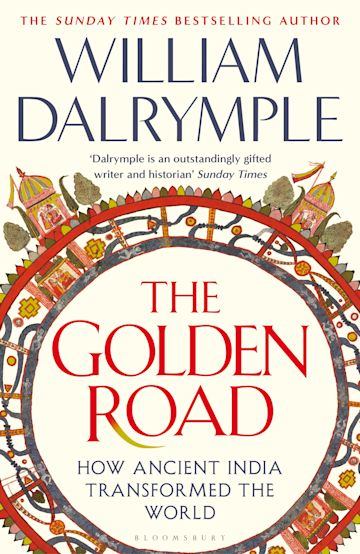
William Dalrymple’s The Golden Road immediately struck me as both capitalizing on and responding to Peter Frankopan’s bestseller, The Silk Roads. As I read Dalrymple’s book, this very much remained my impression. For all the ways Frankopan aimed to center the Eurasian trade routes and Central Asia in world history, Dalrymple makes a strong effort here to ensure that the Indian subcontinent has its say. The project is largely successful, even if the book’s subtitle, “How Ancient India Transformed the World,” and some of its claims get a bit stretched.
With over a hundred pages of endnotes and other addenda attached, The Golden Road is actually a lean, 300-page journey through ancient India’s cultural, scientific, artistic, religious, and economic footprint. The book’s deep dive into Buddhism’s Indian origins and its spread to the Greco-Roman West, China, and the kingdoms of Southeast Asia is a particular strong point that occupies multiple chapters. To a certain extent, I think the best version of this book would have spent its full page count going deeper into this particular religious and philosophical export. Dalrymple is also a particularly strong writer when it comes to tales of political intrigue and power struggles. The stories of Empress Wu Zetian in China and the caliphs and viziers of Abbasid Baghdad were especially gripping.
Dalrymple’s explanations of the importance of other Indian products and inventions (spices, the concept of zero and advanced mathematics, chess, mandala-inspired architecture, great literary works) are also adequate. The real issue is whether they are compelling enough to live up to the book’s thesis. For example, repeatedly stating that Angkor Wat in Cambodia (which was heavily inspired by Indian religion and architecture) was once the most important religious site on earth merely because it is five times larger than Vatican City didn’t ultimately mean very much. The problem that books like this inevitably run into is that they try to elevate one particular culture or civilization’s achievements and significance while at the same time telling the story of globalization and multiculturalism. Without a more specific thesis as to the scope of the book’s claims, its conclusions can come across as overwrought, contrarian, or revisionist to no particular end. The Golden Road veers into this territory at times, but it never overwhelms the otherwise enjoyable and informative read.
If the aim of this book was to convince me that ancient India had a preeminent or singular role in transforming the world, then I’m not particularly convinced. However, it is undeniable that India was a force to be reckoned with and a worthy peer to China, Egypt, Persia, the Arab Caliphates, and the Greco-Roman West, and after reading this book, ancient India feels like less of a blind spot in my understanding of world history.
 The Once and Future Lit