“There are billions of gods in the world. They swarm as thick as herring roe. Most of them are too small to see and never get worshipped, at least by anything bigger than bacteria, who never say their prayers and don’t demand much in the way of miracles. They are the small gods—the spirits of places where two ant trails cross, the gods of microclimates down between the grass roots. And most of them stay that way. Because what they lack is belief. A handful, though, go on to greater things. Anything may trigger it […] because what gods need is belief, and what humans want is gods.”
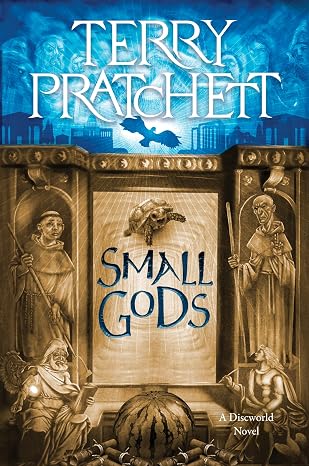
Small Gods is frequently cited as a top-tier Discworld book and, great standalone entry point into Terry Pratchett’s satirical universe. I definitely agree. Of the 13 Discworld books I have read to date, Small Gods probably makes my top three, and of the Discworld standalone novels I have read, it is superior to both Pyramids and Moving Pictures.
In Small Gods, Pratchett satirizes gods and religion. In less capable hands, this could have been treacherous terrain, and I am sure someone out there will take offense on principle. But, in my view, Pratchett’s satire never veers into being mean-spirited, offensive, or unfair. In Small Gods, there are set pieces, jokes, characters, and references that draw from ancient Greek and Egyptian polytheism, Western and Eastern philosophy, Christianity, Islam, and Taoism, among others. I am frequently impressed with Pratchett’s ability to infuse his seemingly-innocent and unserious Discworld with masterful wit, astute analysis of the human condition, and so much heart, and that is very much the case here.
The plot of Small Gods revolves around a relatively simple idea: what if gods grow or shrink in size and power as they gain or lose believers? Enter the great god Om, who, despite being the namesake of the rich and powerful theocratic nation of Omnia, appears as a small, half blind tortoise in the garden of Brutha, the least remarkable novice monk in all of Omnia. Ironically, for all Omnia’s hierarchies, rituals, statues, and temples, Brutha is Om’s only remaining true believer—his earnest faith the only thing keeping Om from becoming a small god (a lost and lonely voice whispering in the desert, in the hope that someday someone will believe in them).
There are many great things about Small Gods. First, Vorbis is a fantastic antagonist. He is the embodiment of the archetypical corrupt religious leader who is so preoccupied with amassing power, upholding dogma, and crushing perceived threats that he has completely lost any connection to real spirituality. Throughout the novel, Vorbis acts so spitefully and selfishly that he seems to not even realize when the very god he purports to serve is right in front of him. Second, this book’s ending is perfect. It was really satisfying to see how Pratchett ended both Brutha and Vorbis’s character arcs and how the recurring image of the desert tied everything together with a positive message about doing the right thing, even when others do not. It is a testament to Pratchett’s understanding of religion’s most important teachings. Third, speaking of the desert, I cannot review this book without mentioning the hermit St. Ungulant. This character was genuinely the most amusing part of this book.
As much as I enjoyed Small Gods, it wasn’t as laugh-out-loud funny as Patchett’s best work. Maybe that was intentional or a result of the subject matter, but it’s worth mentioning. Relatedly, this book seemed to have fewer footnotes (which often contain some of Pratchett’s best jokes) and felt very removed from familiar Discworld settings and characters. I also found the middle section of the book set in Ephebe less compelling than the rest of the story.