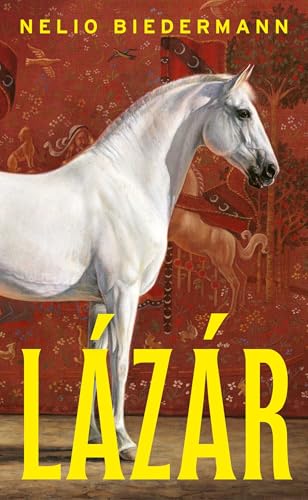
I really enjoyed Lázár. This is a novel that features many of my favorite things. It is a historical fiction set in early twentieth-century Europe, has strong magical realist visuals and a gothic tone. From the very opening passages of the novel, Nelio Biedermann makes it very clear that the aristocratic Lázár family are a troubled bunch plagued by no shortage of mental illness, scandal, emotional repression, and dark secrets. As dysfunctional as the family is, I nevertheless found myself routing for its multi-generational roster of protagonists at almost every turn. Each generation roughly maps onto a major historical period in Hungary’s long twentieth century. Sándor and Maria’s lives and self destructive ends map neatly onto the equally self-destructive and hubristic developments of the 1910s, in which the great European empires (including the Lázár’s native Austria-Hungary) destroyed themselves in an ill-conceived World War. Lajos comes of age in the inter-war period and leads his family as Baron through the rise and fall of the Nazi regime and its Hungarian collaborators. Through this period he struggles with maintaining morality and loyalty. Finally, his children, István and Eva must struggle for their very survival in Hungary’s years under post-war communist dictatorship.
Everything Biedermann included in this novel was very compelling and I was truly impressed with his skills as a young author who lived through none of these traumatic historical events. It reminded me of the ambitious multi-generational historical epics of authors like Ken Follett and Edward Rutherford. Specifically, Lázár reminded me a lot of Follett’s Century Trilogy, in which he traces the histories of five families across the twentieth century. In fact, there are a number of scenes in Lázár that read very similarly to scenes in Follett’s work. The biggest difference, however, is that while Folllett’s books each exceed a thousand pages, Biedermann’s entire multi-generational saga contains fewer than three-hundred pages. I would also argue that Biedermann’s prose is far superior.
Given how little time there is to establish characters and set scenes, I felt Biedermann’s work was convincing and visually compelling. The woods around the manor house felt haunted; the streets of Budapest felt like they actually changed with the times; the sex and violence felt scandalous and shocking without veering into excess. Biedermann is also very skilled at writing setpieces that read like dark fairy tales that really stuck in my head. Almost every scene of personal tragedy or crisis in this book works not only to illustrate a character’s emotional state, but also as an allegory for history itself. This book depicts a woman filling her pockets with rocks and drowning herself, a baby freezing to death in a stroller, and a man falling down a staircase to his death, and each of these scenes is described so well they could each be a beautiful painting in addition to being horrific scenes.
My biggest issue with Lázár is what is not in this book. At times (especially in the back half of the book) it feels as though Biedermann is rushing from scene-to-scene. Characters float in and out of the plot very quickly and there are many multi-year time jumps. This is not inherently a bad thing, but for a novel as ambitious as this one, it did at times feel like Biedermann missed opportunities to add depth to many of the characters. The novel is very preoccupied with chronicling the Lázár family as it experiences great losses, and I think more time spent developing the relationships and possessions at risk would have served the book well.
Overall, I recommend Lázár, and I really appreciate that such an old-school historical fiction novel can still be written and get attention in today’s publishing market. Given Biedermann’s age, this book is very impressive and he should be very proud.