Spoiler warning.
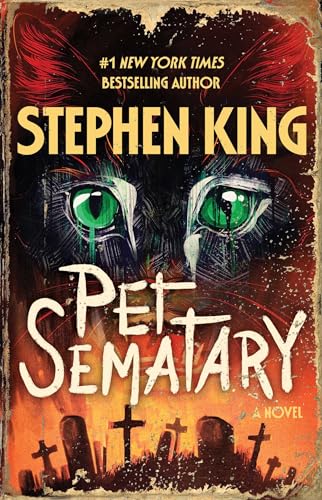
Pet Sematary is often considered among Stephen King’s most frightening works. What surprised me, however, is that most of the horror stems not from jump scares or gore, but from just how deeply, deeply upsetting this book is. On the surface, this is a book about a zombie cat and the power of resurrection, but what really sticks is how relentless King was in exploring death and grief.
Many people, myself included, are uncomfortable with the details of real death and dying — caring for the sick, picking out a coffin, going through the motions of planning a funeral and receiving condolences, processing a great loss while still trying to keep a foot in reality — and King does not let up in this novel. Every significant character in Pet Sematary has a different way of processing or avoiding the subject, and it shows just how much thought King has put into it himself. Ellie, as one would expect of a child her age, is grappling with the concept of mortality for the first time. Her mother, Rachel, is highly avoidant due to her own grotesque childhood trauma, while her father, Louis, has an “I can fix it” stubbornness that aligns with him being a doctor. Meanwhile, Jud and Norma Crandall, the most prominent elderly characters in the novel, appear far more acquainted and comfortable with their mortality. Across four hundred pages of tragedies, deaths, burials, disinternments, and resurrections, these characters really go through the ringer. The level to which King wants his characters and readers to feel uncomfortable is palpable, and it is unlikely any reader will make it through without wondering what choices they would make if they were faced with the tragedy inflicted on the Creed family.
Thematically, Pet Sematary also makes for a compelling exploration of free will versus predestination. There is a lot about this novel that is not subtle, but King remains vague on the nature of the power that emanates from the ancient burial ground. On one hand, readers can interpret it as a supernatural, cosmic force that dooms all those that come under its power, no matter the choices they make. On the other, there are so many moments in Pet Sematary where one minor change in a character’s decision-making or circumstance would completely have changed the outcome. What if Jud never told Louis about the burial ground? What if they never revived Church? What if the family had all stayed together after Gage’s death? What if Rachel never came back? What if Jud had explained everything to Rachel on the phone? What if Rachel spent the night in Portland? You get the idea. Either way, it’s a fascinating thought exercise of nihilism versus tragedy.
All that said, I do not want to give the impression that Pet Sematary is a particularly high-brow read. King’s accessible prose is quite good, but occasionally gets a bit heavy-handed. The descriptions and horrific events in this book are top-tier and will stay with me for a long time. I have not looked at my dog the same way in days, and every description of Church the cat’s resurrected form and behavior left me feeling quite disgusted. The flashbacks to Zelda’s death from spinal meningitis are deeply unpleasant to read, and the way King writes the lead-up to Gage’s tragic death was truly sad. There is almost nothing happy about Pet Sematary, but few books and even fewer authors are capable of delivering such an emotional impact.
I have now read eight Stephen King novels, and Pet Sematary is second only to 11/22/63.
“It’s probably wrong to believe there can be any limit to the horror which the human mind can experience. On the contrary, it seems that some exponential effect begins to obtain as deeper and deeper darkness falls-as little as one may like to admit it, human experience tends, in a good many ways, to support the idea that when the nightmare grows black enough, horror spawns horror, one coincidental evil begets other, often more deliberate evils, until finally blackness seems to cover everything. And the most terrifying question of all may be just how much horror the human mind can stand and still maintain a wakeful, staring, unrelenting sanity.”