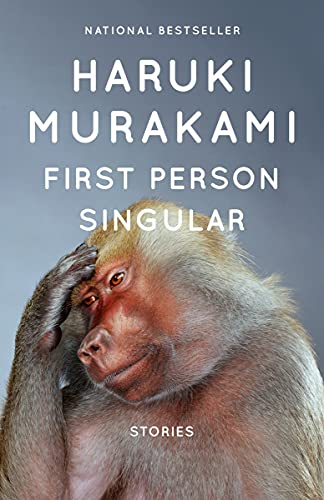
As I wade into Japanese literature, it was only a matter of time before I read a work by Haruki Murakami. I decided this short story collection was a decent place to start, and on the whole, I quite enjoyed it. I love magical realism, so I really enjoyed many of the stories in First Person Singular. Even more than that, however, I really appreciated the themes Murakami returns to across many of these stories; especially his interest in the marks our past relationships have on us as we pass from youth to middle age. My brief thoughts on individual stories are as follows:
Cream – 9/10. The first story in this collection does a great job setting the tone for what is to come. The old man’s words to the protagonist on the mountain top really stuck with me. The idea that “There’s nothing worth getting in the world that you can get easily,” is one I reflect on often, and Murakami’s exploration of that idea here made me want to take a highlighter to several passages in this story.
On A Stone Pillow – 9/10. A reflection on how the people we cross paths with in life – even briefly – can leave a lasting imprint on us. In this somewhat dark tale of a one-night stand, Murakami plays with the idea of meaningful relationships, memory, and what it means for someone to be alive, whether through their physical presence, their words, or memory. In my head canon, the woman in this story, and the protagonist’s girlfriend in With the Beatles, are one and the same. Both are women from his youth who symbolize a loss of innocence and trigger meditations on the outsized emotional resonance of our young lives.
Charlie Parker Plays Bossa Nova – 7/10. It took a few pages for me to warm up to this story. In it, the protagonist gives a deceased musician a second life of sorts by writing what amounts to fanfiction. The protagonist, a long-time fan of saxophonist Charlie Parker, laments that the musician died at the young age of 34 in 1955, and writes an alternate reality where Parker lived long enough to play the bossa nova music of the early 1960s. The protagonist builds out this “what if” scenario, writing Parker an entire album in the genre. When Parker’s ghost visits the protagonist in a dream and thanks him for making this happen, Murakami asks us to ponder what it means for something to be “real.”
With the Beatles – 8/10. The framing device referencing The Beatles and pop music of the 1950s and 1960s felt a bit out of place in this story. The core of the narrative has very little to do with The Beatles at all. Instead, Murakami once again writes from the perspective of an adult male protagonist looking back on an adolescent romantic relationship. In this story, Murakami plays with our expectations. He does an excellent job creating unease by exploring the protagonist’s girlfriend’s family dynamic (especially her mentally ill brother), but then flips the narrative, showing that life does not always go the way we expect. Just because someone is successful or healthy in one chapter does not guarantee flourishing in another. This story also dabbles with the theme of accountability and guilt. Should we (and to what extent) feel responsible for other people’s fates?
Confessions of a Shinagawa Monkey – 9/10. This is a story about a talking monkey who gives back rubs in a hot springs spa, and confesses his proclivities for falling in love with human women and stealing their names. Wonderfully weird!
Carnaval – 7.5/10. It’s easy for this story to seem unkind to women, based on the premise of the protagonist telling the story of his friendship with the “ugliest” woman he ever knew. But if you can get past that, this is actually a thoughtful examination of what it means to know someone. How do we allow perceived beauty and ugliness to affect our expectations of others, and how can that be weaponized against us? This is also a reflection on friendships built on a single shared interest or activity that gradually dissipate when that unifying element no longer remains.
The Yakult Swallows Poetry Collection – 7/10. This non-fiction entry by Murakami explores the author’s relationship to baseball, and how his fandom echoes other aspects of his life, from his strained relationship with his father to the development of his writing career. The baseball poetry is beside the point here (unless that’s really your thing).
First Person Singular – 8/10. The titular story unites many of the themes and features of the stories in this collection. Once more, we follow a male protagonist who seems at odds with life and his place in society. He occasionally dons the unworn suits and dress shoes in his closet and walks around town, if only so he can experience a different flavor of life on occasion. Like some of the earlier entries, he encounters a woman who claims to be from his past, once again asking us as readers to reflect on the imprint even fleeting encounters leave on those involved.
 The Once and Future Lit