
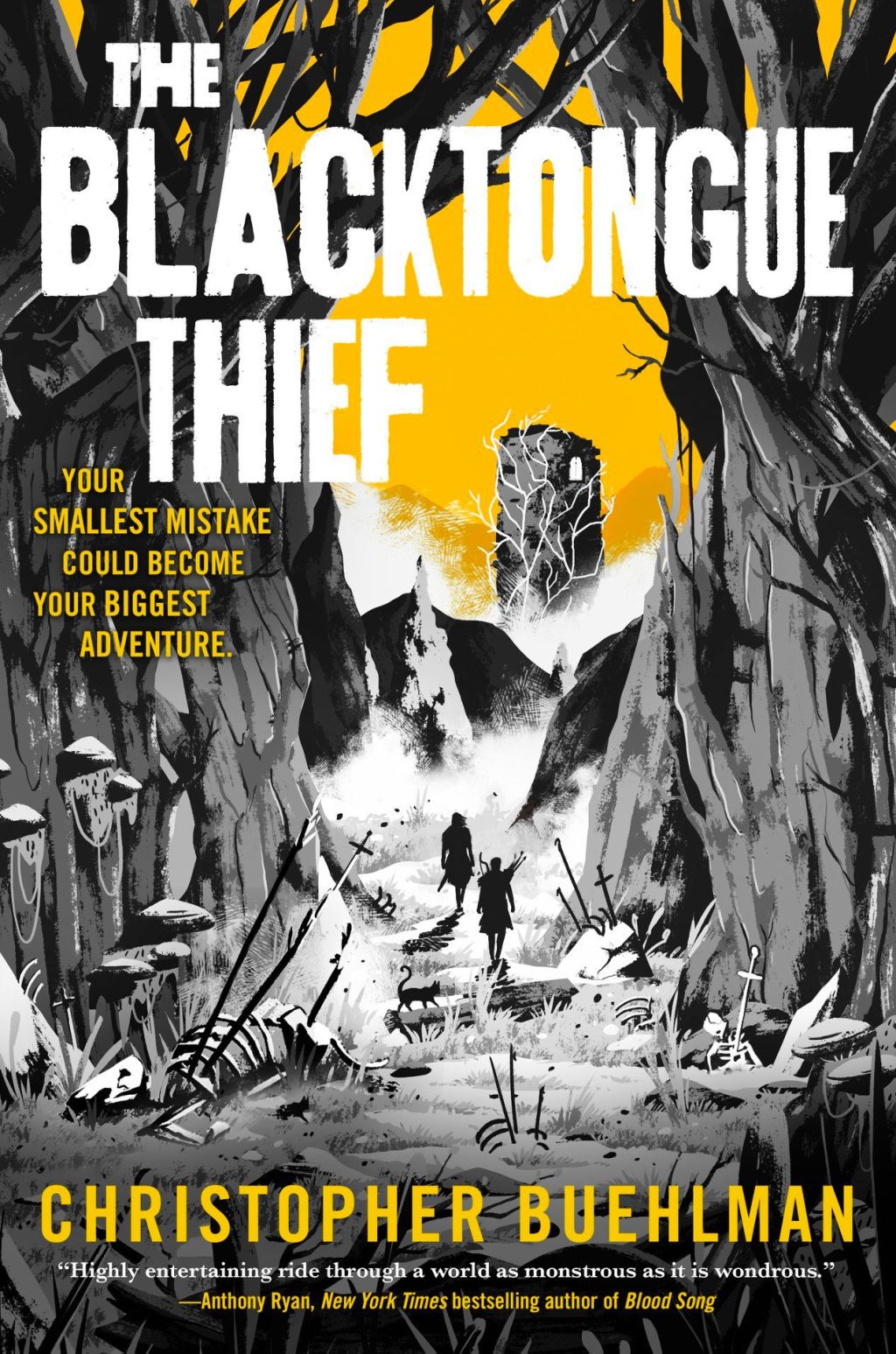
The Blacktongue Thief is the funniest, goriest, sexiest, and creepiest fantasy novel I have read to date. I picked up this novel because I was intrigued by Christopher Buehlaman’s reputation for blending fantasy with horror and thought this would be a tonal shift from the abundance of Terry Pratchett and Brandon Sanderson books I have had in heavy rotation over the last year. This book absolutely delivered. The Blacktongue Thief reads like the twice-cursed bastard child of Elden Ring and Pirates of the Caribbean, and I loved it. When I decided to read The Blacktongue Thief, I was under the impression that it was a standalone story set in a bigger world (akin to Samantha Shannon’s The Priory of the Orange Tree). As it turns out, this is not the case. In addition to the prequel novel, The Daughters’ War, Buehlman is writing a sequel, The Thrice-Bound Fool, and I will happy read both.
The fact that a sequel is incoming already minimizes my only criticism of this book–the ending. This is not to say the ending was bad. It simply did not reach the high levels of shock value that enthralled me for the first three-hundred pages.
Other than that, however, this book is a near-perfect irreverent, swashbuckling adventure. Unlike many books that claim to be funny, this one actually is. The dynamic between the main protagonist, Kinch Na Shannack, an uncouth scoundrel, and Galva, the no-nonsense warrior is fantastic and dripping with sarcasm and snark. The jokes themselves are often raunchy or grotesque, but what really made me chuckle was Galva’s at-times naive, at-times judgmental response to Kinch’s sense of humor.
I also really want to applaud Buehlman on his characterization and world-building. In many ways, the characters, creatures, and landscapes in The Blacktongue Thief are very familiar. Thieves guilds, warriors, witches, goblins, giants, assassins, and sea monsters are hardly new to the fantasy genre, but Buehlman’s take on these archetypes and tropes are really memorable. As a writer, he is a master at conveying striking images and descriptions and developing magic systems and cultures. Examples include the revelation of Deadlegs the witch’s physical condition, the goblin ship, magic tattoos, and Sesta the Assassin living inside Bully the blind cat. In merely four hundred pages, Buehlman succeeds on taking readers on a journey across a continent that feels lived in and full of diverse cultures and fantasy creatures. He even takes the time to integrate currency systems, in-world card games, different religions, and the demographic consequences of recent warfare into the world in ways that feel integral to the plot.
I understand that this particular genre of fantasy pre-dates Buehlman, but I am very happy that The Blacktongue Thief was my first foray into the darkness. To put it in a way Kinch na Shannack might prefer, it wasn’t shyte.
 The Once and Future Lit